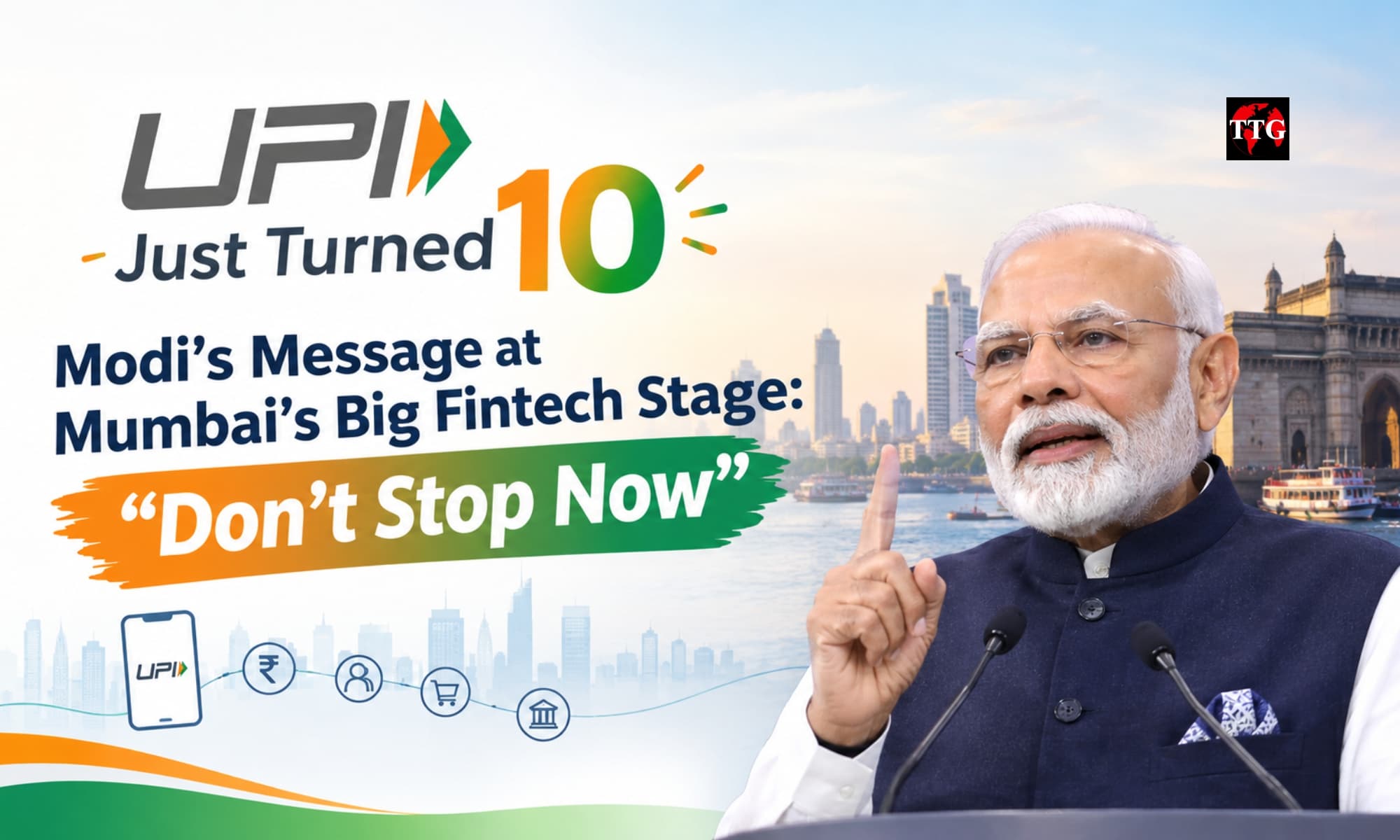
UPI Just Turned 10. Modi's Message at Mumbai's Big Fintech Stage: Don't Stop Now.
Key Takeaways
- UPI quietly turned 10 years old on August 25, 2026 — and in August alone, it processed more than 24 billion transactions.
- Prime Minister Narendra Modi opened the 7th Global Fintech Fest in Mumbai on September 8, calling it his "hat-trick" appearance at the event, and used the stage to push fintech companies toward UPI's next chapter.
- His ask was specific: stop treating UPI as just a payments app. Expand it into savings, credit, insurance, and pensions — and start linking it to payment systems in other countries.
- New UPI-linked credit facilities were also announced, letting farmers with Kisan Credit Cards and small businesses with PM MUDRA loans spend their sanctioned credit directly through UPI at merchant checkout.
- UPI is now live in 11 countries and handles close to half of all real-time digital payment transactions worldwide.
A Birthday Nobody Really Stopped to Celebrate
Ten years is a long time for any piece of technology to stay this relevant, let alone one that most people use without thinking twice about it. On August 25, UPI — the system that lets you scan a QR code at a vegetable cart and pay in two seconds — quietly crossed its tenth anniversary. There was no big fanfare on the day itself. The real moment came two weeks later, on September 8, when Prime Minister Narendra Modi stood up in Mumbai to open the Global Fintech Fest and made UPI's first decade the centerpiece of his speech.
If you've used UPI even once — and if you're in India, you almost certainly have — it's worth pausing on how far this has actually come. Ten years ago, sending money to someone meant a bank transfer that took hours, or cash, or a cheque that could bounce. Today, August alone saw more than 24 billion UPI transactions. Not in a year. In one month. That's not a success story anymore. That's basic national infrastructure, the same category as roads and electricity.
What Modi Actually Asked For
Modi called his appearance at this year's Global Fintech Fest a "hat-trick" — his third year in a row at the event, tied neatly to his government's third consecutive term. But he didn't spend his time on stage patting the industry on the back. He spent it pushing them toward the next problem.
His message, stripped of the formal language, was pretty simple: UPI winning at payments isn't the finish line, it's the starting line. He specifically called on fintech companies to stop thinking of UPI as "just payments" and start building savings tools, credit products, insurance, and pension access on top of it — the same rail that already moves money for a billion people, now doing more than just moving it.
He also pushed on something that matters a lot for anyone with family abroad: connecting UPI directly to payment systems in other countries, specifically to cut down remittance costs for the Indian diaspora. If you've ever sent money home from overseas and watched a chunk of it disappear into transfer fees, this is the problem he was talking about solving.
And he laid out four things he wants the industry to actually take seriously going forward, not just talk about: stronger cybersecurity, data protection standards the industry adopts on its own rather than waiting to be forced into, closer coordination with regulators like the RBI, and a new Fintech Consumer Protection Index — essentially a scorecard to keep the industry honest as it grows.
The Part That Actually Affects Regular People Right Now
Buried inside the bigger speech was a genuinely useful, concrete announcement: new UPI-linked credit facilities for farmers and small businesses. If you hold a Kisan Credit Card or a PM MUDRA loan, you'll now be able to use your sanctioned credit limit directly through UPI at the point of payment — no separate withdrawal, no extra step. For a farmer buying seeds or a small shop owner restocking inventory, that's the difference between credit that exists on paper and credit you can actually use in the moment you need it.
This is the kind of detail that doesn't make flashy headlines but genuinely changes how money moves for people who don't have easy access to traditional banking. It's also very on-brand for how UPI has grown over the last decade — less about flashy tech, more about quietly removing friction from everyday transactions for people who needed it most.
Why This Matters Beyond India
Here's the number that puts all of this in perspective: UPI now accounts for close to half of every real-time digital payment made anywhere in the world, and it's already operational in 11 countries. That's not India catching up to global fintech. That's India having built the global fintech model that other countries are now trying to plug into.
The subtext of Modi's speech — the growth-boosting 7.8% GDP number he mentioned, achieved even during a quarter when tensions in West Asia were creating real global economic uncertainty — was really about confidence. The message to the 100,000-plus delegates, 5,000-plus startups, and hundreds of investors gathered in Mumbai this week was: the first ten years proved this works. The next ten need to prove it can be the backbone for a lot more than payments — and it needs to work for the rest of the world too, not just India.
The Simple Version
UPI turned 10. It's bigger and more essential than most people realize — 24 billion transactions in a single month, live in 11 countries, handling nearly half the world's real-time digital payments. At India's biggest fintech stage this week, the Prime Minister's message to the industry wasn't "well done." It was "now do more" — savings, credit, insurance, pensions, and global reach, all riding on the same simple system people already trust to split a dinner bill in two seconds.