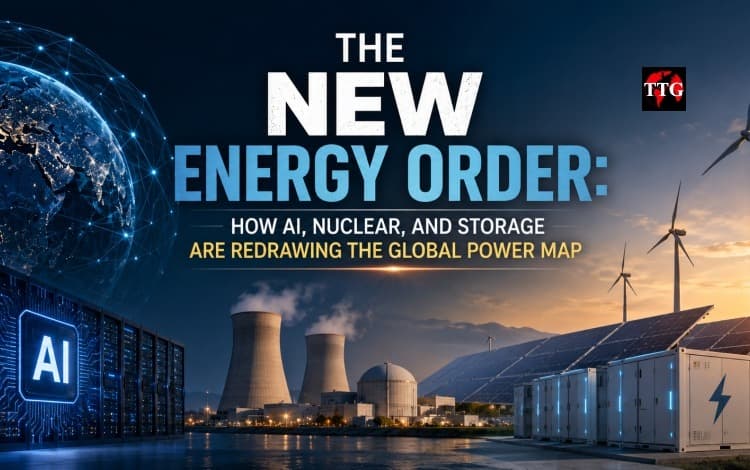
The New Energy Order: How AI, Nuclear, and Storage Are Redrawing the Global Power Map
Key Takeaways
- Renewable generation grew by 9.8% in 2024 to reach 31.7% of global electricity (9,836 TWh), with solar surging 29.7% year-on-year.
- AI data centre expansion is creating an unprecedented demand pull for 24/7 firm, zero-carbon baseload power like nuclear, SMRs, and geothermal.
- Hyperscalers are making multi-gigawatt nuclear infrastructure bets, such as Meta's 6.6 GW nuclear agreements and Google's 500 MW Kairos SMR deal.
- US operating battery storage reached 37.4 GW in 2025, providing the fastest bridge to firming clean energy as long-lead baseload projects develop.
IRENA's Renewable Energy Statistics 2026 shows that renewable electricity generation grew by 9.8% in 2024 — significantly higher than the growth rate recorded in 2023. Non-renewables continued to fall behind with an increase of just 1.4% over the same period. Overall, renewables accounted for 31.7% of global electricity generation, totalling 9,836 terawatt hours. Solar generation alone was up 29.7% year-on-year — the fastest growth of any generation technology in history.
The Demand Shock: AI and Data Centre Growth
Yet even as renewables break records, the energy system is confronting a demand shock that no projection from three years ago anticipated at this scale. The major trends defining the green economy landscape in 2026 really come down to data centre development. We are behind on baseload power, and there is a ton of demand pull-through for small nuclear reactors, fusion technology, geothermal, and other emerging technologies that can help facilitate and deliver that power to the market.
Hyperscalers are driving unprecedented demand for firm, low-carbon power. The United States hosts 90% of hyperscalers' global carbon-free energy contracts, with renewables supplying 78% and nuclear providing the rest. Battery storage is the fastest bridge to 24/7 clean power, as clean baseload options like nuclear, hydro, enhanced geothermal, and natural gas with carbon capture take years to develop. By October 2025, US operating storage capacity reached 37.4 GW, up 32% year to date. Another 19 GW is under construction through 2026, with a 187 GW pipeline.
Hyperscale Nuclear Bets
The investment flows reflect this reorientation. Meta announced deals for up to 6.6 GW of nuclear capacity through TerraPower (8 Natrium plants at 2.8 GW), Oklo (1.2 GW Aurora campus), and utility PPAs. Google signed the first US corporate SMR fleet deal with Kairos Power for 500 MW. These are not sustainability commitments. They are infrastructure bets — the recognition that the hyperscale AI economy cannot run on intermittent power, and that nuclear is the only proven baseload clean energy technology that can be contracted at the scale required.
Geopolitical & Economic Imperatives
The BloombergNEF New Energy Outlook 2026 finds that countries reliant on imported fossil fuels can materially reduce exposure to price shocks as electrification and clean power scale. Energy security has risen to the top of the policy agenda — and nations that adopt clean power at scale will be structurally more resilient than those that do not.
The energy transition of 2026 is no longer primarily a climate story. It is a security story, a competitiveness story, and an infrastructure story. The nations and organisations that move fastest will carry an advantage that compounds for decades.
Frequently Asked Questions
What percentage of global electricity was generated by renewables according to IRENA 2026?
Renewables accounted for 31.7% of global electricity generation (9,836 TWh), with solar generation surging by 29.7% year-on-year.
Why are hyperscalers investing heavily in nuclear power?
AI data centers require uninterrupted 24/7 baseload power that intermittent solar and wind alone cannot provide without massive storage, making nuclear the primary scalable firm clean energy solution.
Where are most global hyperscale carbon-free energy contracts located?
The United States hosts 90% of hyperscalers' global carbon-free energy contracts, with renewables providing 78% and nuclear supplying the remainder.