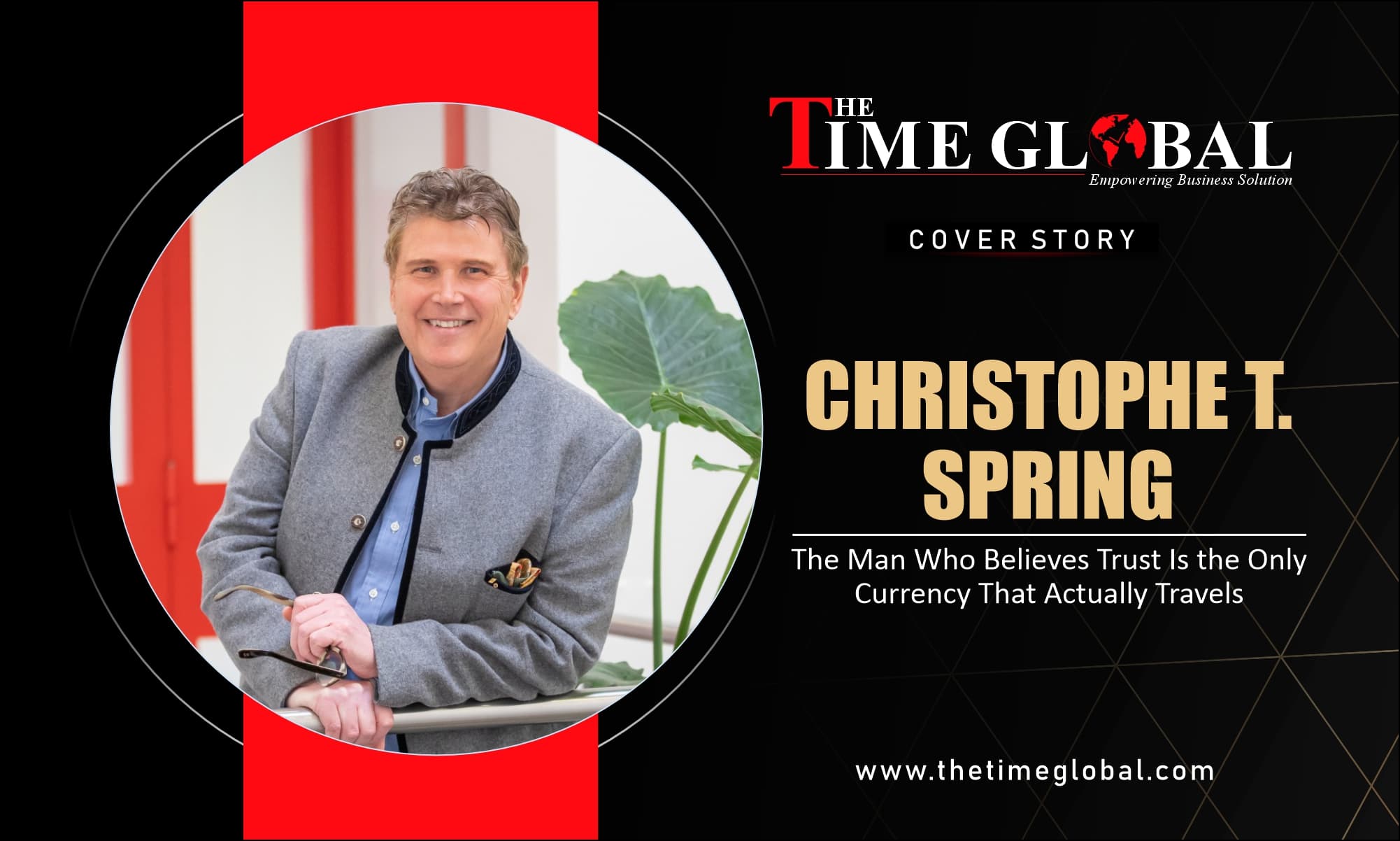
The Man Who Believes Trust Is the Only Currency That Actually Travels
Key Takeaways
- Trust as Currency: Success in international markets depends more on building trust and credibility than merely possessing capital.
- Market Reality vs. Boardroom Ambition: Effective strategy requires staying close to the marketplace and adapting to local commercial realities.
- Building Ecosystems: Successful expansion requires collaborative platforms that connect governments, investors, and entrepreneurs.
- The Ninety-Day Rule: Prioritize observation and validation over immediate execution when entering new markets.
The Man Who Believes Trust Is the Only Currency That Actually Travels
International business fascinated Christophe T. Spring long before globalisation became a business buzzword. Early in a career now spanning more than four decades across sales leadership, export, FMCG, premium brands, retail, and travel retail, he arrived at a conviction that has never left him: success is rarely decided by the quality of a product alone. Outstanding products fail every day, he points out, while ordinary ones sometimes become global successes, because they are carried by the right people, the right partnerships, and the right market strategy.
Every market, he has learned, operates according to its own commercial logic. Regulations differ. Consumer expectations evolve. Culture shapes decision-making in ways a spreadsheet never captures. That complexity, rather than deterring him, has been the pull of his entire career. Today, as Executive Board Member and Vice President of Global SME Business Home (GSBH), his focus has not shifted: creating the connections that let companies grow beyond borders, and giving entrepreneurs access to markets they once considered unreachable.
For Christophe T. Spring, expansion was never really about geography. "Companies don't become global when they cross borders. They become global when customers abroad begin trusting them as if they were local," he says.
The Boardroom Defines Ambition. The Marketplace Defines Reality.
Balancing governance at GSBH with hands-on international business development is not, in Christophe T. Spring's view, a matter of choosing sides. Boards define direction, he says, but markets determine whether that direction is correct, and when leadership loses contact with customers, distributors, entrepreneurs, and local realities, strategy gradually becomes theoretical.
He has made a deliberate habit of staying close to the marketplace throughout his career, whether working with ambassadors, chambers of commerce, government representatives, or family-owned businesses. Every conversation, he says, offers insight no report or dashboard can fully replace. At GSBH, where the mandate is to connect institutions, governments, and entrepreneurs across continents, his job is to keep strategy practical and turn opportunity into measurable outcomes.
"The boardroom defines ambition. The marketplace defines reality."
From Networks to Ecosystems
Most organisations build networks, Christophe T. Spring says. GSBH's ambition is to build ecosystems, and the distinction matters more than it might first appear. Networks connect people. Ecosystems enable cooperation. When SMEs expand internationally, they rarely face one isolated challenge; they need market intelligence, trusted introductions, financing, legal guidance, local knowledge, and strategic partners, often simultaneously.
By bringing governments, diplomatic missions, investors, entrepreneurs, chambers of commerce, universities, and private companies onto one collaborative platform, GSBH creates something considerably more valuable than a contact database, he argues. It creates momentum. "The real value of a network is not who you know. It is who is willing to open the next door for you," he says.
Clarity Before Capital
Ask Christophe T. Spring what businesses actually need to expand globally, and capital is not his first answer. Clarity is. Companies need a realistic understanding of where they can create value, which markets deserve priority, and whether their competitive advantage actually travels internationally. Capital accelerates execution, in his framing; it does not replace strategy. Conferences and trade fairs create visibility, not necessarily commercial success. Real expansion, he insists, begins after the event, sustained by companies that follow up consistently, listen carefully, adapt quickly, and invest patiently in relationships.
That same discipline shapes his advice for a company's first ninety days in any new market. He divides the period into three phases: observe, validate, execute. Observe the competitive landscape, regulations, customer behaviour, and local business culture. Validate assumptions by speaking directly with customers, distributors, chambers of commerce, government agencies, and industry experts. Only then, he says, should meaningful investment follow. Companies often believe speed creates competitive advantage; in his experience, informed decisions create sustainable growth. The objective of those first ninety days, as he puts it, is not maximum activity, but minimum uncertainty.
The Gulf, Reconsidered
Few regions have transformed as dramatically in the past decade as the Gulf, and Christophe T. Spring is direct about how many Western companies still approach it with assumptions that no longer hold. Today's GCC economies are ambitious, innovative, and globally connected; customers are sophisticated, governments are investing heavily in diversification, and competition has become increasingly international.
Success there, he argues, requires arriving with humility: understanding local culture, respecting business etiquette, identifying trustworthy partners, and committing to the market for the long term. Businesses chasing quick wins in the Gulf, he has found, tend to leave disappointed. Those prepared to build genuine, patient partnerships frequently discover opportunities well beyond what they originally expected.
Switzerland's Greatest Export
Christophe T. Spring traces part of his own approach to the country he calls home. Switzerland is known for precision, quality, stability, and trust, and that reputation opens an initial door, he says, but international business quickly becomes personal. Every negotiation, every commitment, and every partnership ultimately rests on the credibility of the people involved, regardless of geography.
Working with entrepreneurs, multinational corporations, ambassadors, chambers of commerce, and government representatives across Europe, the GCC, and Asia has taught him one universal truth, he says: people invest in people before they invest in companies. "National reputation may open the first conversation. Personal integrity determines whether there will be a second," he says.
The Right Market, Wrong Assumptions
The single most common mistake he sees is companies assuming that success at home will automatically translate abroad. It rarely does. Every international market carries its own commercial DNA, shaping consumer behaviour, pricing expectations, distribution channels, regulation, and cultural values. Companies that ignore those differences, he says, often discover that an excellent domestic strategy becomes an expensive international lesson.
"The greatest risk is not entering the wrong market. It is entering the right market with the wrong assumptions."
Trust Cannot Be Negotiated
Across cultures, Christophe T. Spring has arrived at a simple distinction: contracts define responsibilities, but relationships determine resilience, and when unexpected challenges arise, as they always do, it is trust that keeps partnerships together. Every culture, in his experience, has written rules and unwritten ones, and companies usually prepare well for the written rules while the unwritten ones quietly determine outcomes.
Respect local custom. Listen carefully. Deliver consistently. Never promise what cannot be achieved. People rarely remember every presentation delivered to them, he says, but they always remember whether a partner kept their word.
Information Is Abundant. Judgement Is Scarce.
On artificial intelligence, Christophe T. Spring is neither dismissive nor uncritical. AI represents one of the most significant productivity revolutions of this generation, enabling companies to analyse markets, compare competitors, and process enormous volumes of information in minutes rather than weeks, creating opportunities for SMEs that once belonged only to large multinationals.
But he is wary of the illusion it creates. Technology can recommend a distributor; it cannot determine whether that distributor deserves trust. It can analyse economic indicators; it cannot read the atmosphere in a negotiation or notice the subtle signals experienced business leaders instinctively pick up on. The future, in his view, does not belong to companies using AI. It belongs to companies combining AI with human wisdom.
Sustainability as a Leadership Philosophy
Christophe T. Spring resists treating sustainability as a compliance exercise or a marketing campaign. He frames it instead as a leadership philosophy: creating economic value while respecting people, resources, and future generations. For SMEs, that means resilient supply chains, investment in employees, less waste, and decisions built to remain valid well beyond the next quarterly report. Profitability and sustainability, in his view, are no longer competing priorities. They have become mutually dependent.
What Governments Owe Entrepreneurs
Governments cannot create entrepreneurs, Christophe T. Spring argues, but they can create the environments in which entrepreneurs succeed. SMEs, in his experience, rarely lack ambition; they lack time, resources, and administrative capacity. Simpler regulation, efficient customs procedures, and stronger collaboration between governments, chambers of commerce, and industry would meaningfully improve global competitiveness, provided the goal remains enabling fair competition rather than shielding businesses from it.
The Redistribution of Economic Influence
Asked which global trend Western companies still underestimate, Christophe T. Spring points to a structural shift rather than a cyclical one: the redistribution of economic influence itself. For decades, many companies treated Europe and North America as the centre of global growth. The GCC, India, Southeast Asia, and parts of Africa are no longer simply emerging markets in his assessment. They are increasingly shaping global markets outright, and Western companies still operating on outdated assumptions risk missing one of the defining economic transformations of this generation.
Trust First. Business Second.
A partnership becomes genuinely strategic, in Christophe T. Spring's view, when both organisations become stronger together than either could become independently, a result that requires shared values, complementary capabilities, mutual respect, and complete transparency, not simply a signed contract. Many partnerships begin with enthusiasm; the ones that last survive because they keep creating value long after the initial excitement fades.
The Difficult Conversations
The most valuable leadership lesson of his career, Christophe T. Spring says, is that leadership is tested most when telling the truth becomes uncomfortable. Surrounding yourself with people who always agree with you, he has found, is one of the fastest ways to lose touch with reality. Some of his most important decisions were unpopular at the time; looking back, integrity has consistently proven a better long-term strategy than convenience.
"Leadership is not measured by the applause you receive. It is measured by the difficult conversations you are prepared to have."
Not the Contracts. The People.
Looking back across four decades in international business, Christophe T. Spring says his greatest satisfaction has never been a title, an award, or a successful negotiation. It has been watching people succeed because someone believed in them and opened a door: entrepreneurs connected with investors, companies with international partners, ambassadors with business leaders. Those connections, he has found, create ripple effects far beyond the original meeting, new companies, new jobs, new friendships, markets made more accessible.
"When I look back, I do not remember the contracts first," he says. "I remember the people."
A Vision for the Next Decade
Christophe T. Spring believes international commerce is entering one of its most exciting periods, with technology reducing distance, AI accelerating knowledge, and young entrepreneurs thinking globally from the day they establish a company. Against that, he sets a sober counterweight: rising geopolitical complexity, economic uncertainty, and cultural fragmentation make responsible leadership more important than ever.
His own mission, he says, has not changed: to build bridges between countries, to create opportunity where others see obstacles, and to connect entrepreneurs, governments, institutions, and investors in ways that generate sustainable prosperity for everyone involved.
"The future of global business will not be shaped by those who build the biggest companies. It will be shaped by those who build the strongest relationships."
Global business, in Christophe T. Spring's final reckoning, was never really about moving products across borders. It is about moving ideas, building trust, creating opportunity, and bringing people closer together, a purpose he has spent forty years pursuing and shows no sign of abandoning.
Frequently Asked Questions
Who is Christophe T. Spring?
He is the Executive Board Member and Vice President of Global SME Business Home (GSBH), recognized as a leading expert in international business expansion.
What is Christophe T. Spring's philosophy on global expansion?
He believes that companies become truly global when they build trust with foreign customers as if they were local, prioritizing credibility over capital.