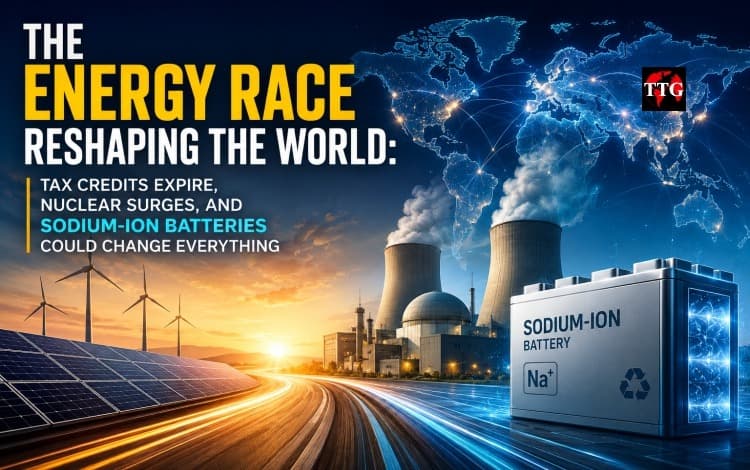
The Energy Race Reshaping the World: Tax Credits Expire, Nuclear Surges, and Sodium-Ion Batteries Could Change Everything
Key Takeaways
- US tax credit phaseouts under the One Big Beautiful Budget Act trigger a developer rush to front-load wind and solar projects before deadlines.
- Battery storage retains US tax credit eligibility through 2035, signaling policy prioritization of grid storage over generation subsidies.
- The UK commits £599 million to Rolls-Royce SMRs and £2.5 billion for Wylfa, while China's Linglong One 125 MWe SMR prepares for commercial operation.
- CATL's sodium-ion battery cells drop to ~$19/kWh, undercutting lithium iron phosphate ($55-$60/kWh) and threatening to solve grid-scale renewable intermittency.
The global energy landscape shifted on multiple fronts this week in ways that will define the decade ahead.
Renewable Tax Credit Phaseouts Trigger Developer Scramble
In the United States, the most consequential policy development in renewable energy in years came into effect on July 4, 2026 — the expedited phaseout of the 45Y and 48E tax credits for wind and solar projects beginning construction after that date. Residential solar lost its 25D credit after 2025. The moves, embedded in the One Big Beautiful Budget Act, have triggered a scramble among developers to front-load construction and secure safe-harbour eligibility before the window closes.
Battery storage, however, retains its tax credits for projects beginning construction by 2035 — a deliberate policy signal that the administration views storage, not generation subsidies, as the more strategically important intervention.
A new analysis published this week by Lazard confirms that unsubsidised renewable energy remains the most cost-competitive form of new-build generation in the United States, despite rising cost pressures. That finding matters because it suggests the renewable industry's commercial fundamentals are sound even as the policy tailwinds weaken.
Nuclear Acceleration in the UK and China
On the nuclear front, the UK's National Wealth Fund committed a £599 million loan facility to Rolls-Royce SMR this April, anchoring a broader £2.6 billion Spending Review allocation and a £2.5 billion SMR acceleration package supporting Great British Energy-Nuclear's three-unit Wylfa programme on Anglesey.
Meanwhile, China's Linglong One — a 125 MWe small modular reactor — is expected to begin commercial operation in the first half of 2026, making it the world's first land-based commercial SMR. The West is watching closely as China demonstrates factory-built modular reactor operations ahead of Western competitors.
Battery Breakthrough: Sodium-Ion at $19/kWh
Perhaps the most quietly significant development of the week came from battery technology. CATL's new sodium-ion battery cell costs roughly $19 per kilowatt-hour at the cell level, compared to standard lithium iron phosphate cells at $55 to $60.
That price gap matters because grid-scale energy storage has been stuck behind a cost wall that holds back many renewable projects. A technology that costs less than a third of its predecessor and is entering mass production could be the unlock that makes 24/7 renewable power economically viable at scale — years ahead of most industry forecasts.
Frequently Asked Questions
What changes happened to US solar and wind tax credits in July 2026?
The One Big Beautiful Budget Act introduced expedited phaseouts for 45Y and 48E tax credits for wind and solar projects starting construction after July 4, 2026, while retaining battery storage credits through 2035.
What progress has been made in SMR deployment globally?
The UK allocated £2.6B to SMR acceleration and Rolls-Royce SMRs, while China's Linglong One (125 MWe) is set to become the world's first operating land-based commercial SMR in 2026.
How cheap are CATL's sodium-ion battery cells?
CATL's sodium-ion battery cells cost roughly $19/kWh at the cell level, compared to $55-$60/kWh for standard lithium iron phosphate (LFP) cells.