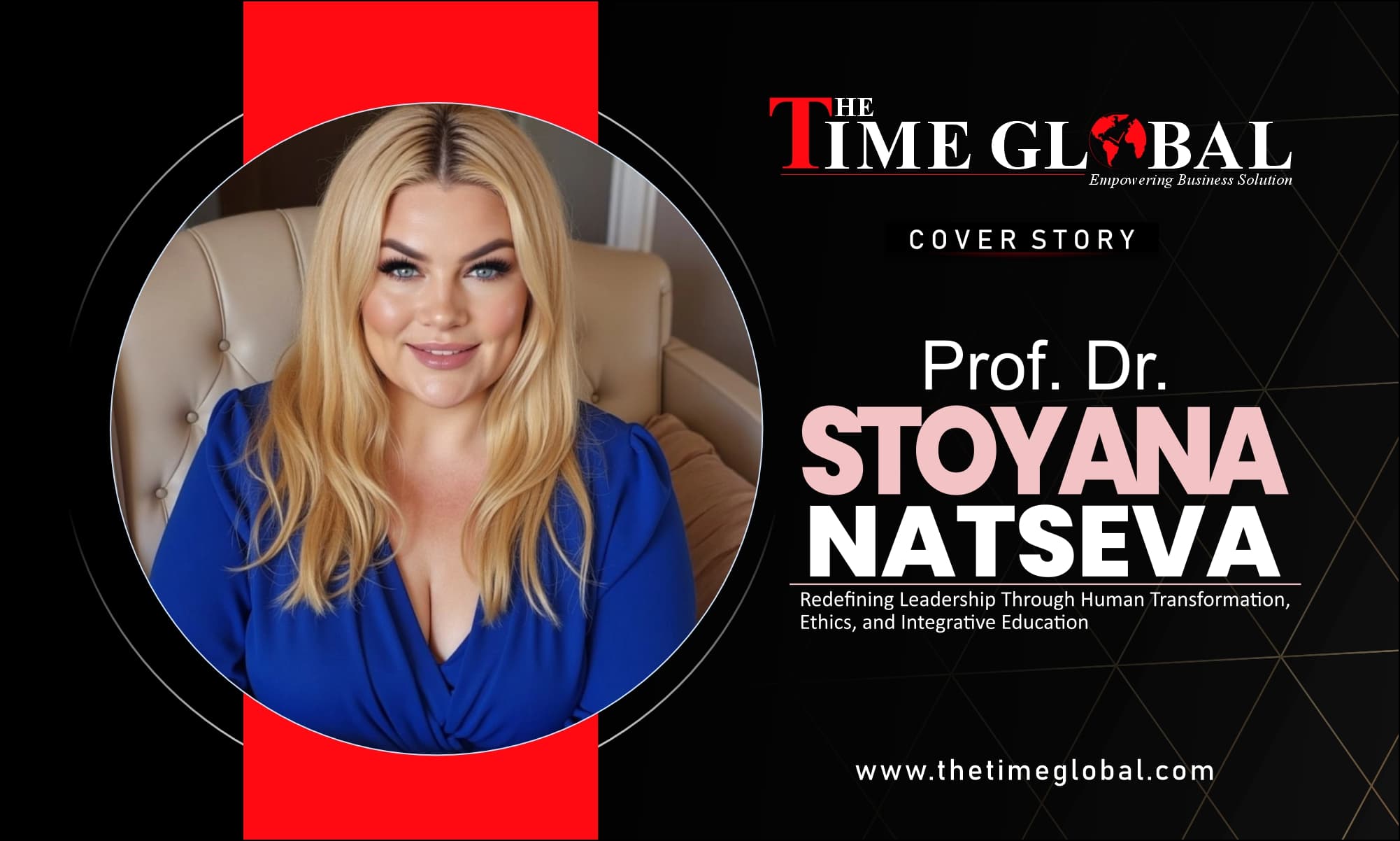
Redefining Leadership Through Human Transformation, Ethics, and Integrative Education
Key Takeaways
- Human-Centric Leadership: Prof. Dr. Stoyana Natseva views leadership as a responsibility rather than authority, emphasizing the human psyche behind organizational structures.
- Systemic Leadership: She advocates for leadership that integrates ethics, innovation, evidence, and human sensitivity.
- Educational Transformation: She introduced scalable educational structures and competency-based curricula while prioritizing clarity, human stability, and strategic adaptability.
- Ethics and Mentorship: She views ethics as the foundation of governance and focuses on mentoring the next generation to be independent, critical thinkers.
Prof. Dr. Stoyana Natseva, PhD, DBA
In a world where leadership is often measured through titles, rankings, and institutional scale, Prof. Dr. Stoyana Natseva represents a different paradigm one rooted not in authority, but in responsibility. Her work stands at the intersection of psychology, education, and systems thinking, and her influence extends far beyond classrooms or academic publications. She has quietly been shaping something far more enduring: the way institutions understand human potential.
Her professional journey did not begin in academia. It began in the demanding, structured environments of economics, finance, and corporate leadership. In senior roles within the banking and corporate sector, she navigated complex decision-making systems, operational risk, and organizational strategy. Yet, over time, she recognized a deeper truth.
Behind every organizational structure and financial framework stood something far less measurable the human psyche.
Beliefs, motivation, trauma, perception, and meaning were influencing outcomes more profoundly than any model or algorithm. This realization became a turning point. Rather than simply optimizing systems, she chose to understand people.
From Systems to Psychology
Her transition into psychology and doctoral research was not a career change it was an expansion. Dr. Natseva began exploring the relationship between cognition, autobiographical memory, resilience, and leadership transformation. She observed that many institutions excelled in technical expertise but struggled to create genuine human growth.
What she saw was a missing bridge between academic knowledge and real-life change.
Instead of pursuing leadership for visibility, she pursued it out of responsibility a responsibility to design educational systems capable of transforming individuals, not merely certifying them. This philosophy would later define her academic leadership and institutional vision.
Leadership Beyond Hierarchy
For Dr. Natseva, leadership is not hierarchical. It is systemic.
In today’s global academic environment, she believes leadership requires integration ethics, innovation, evidence, and human sensitivity must function together. Authority, she argues, no longer comes from position alone, but from intellectual credibility and accountability.
Her role, as she sees it, is that of a translator: translating theory into practice, research into application, and knowledge into impact.
More importantly, she emphasizes courage the courage to challenge outdated educational systems, confront intellectual stagnation, and defend academic truth in an era saturated with information but often lacking understanding.
Transforming Institutions Through Clarity
Higher education is undergoing rapid transformation, and Dr. Natseva has led institutions through periods of uncertainty by prioritizing clarity over reaction. Her leadership rests on three pillars:
Academic standards
Human stability
Strategic adaptability
She introduced modular and scalable educational structures, hybrid learning models, and competency-based curricula, ensuring institutions could evolve without sacrificing rigor.
Yet her leadership is not only structural it is psychological. She recognizes that people resist change when they feel threatened but embrace it when they feel part of a meaningful mission. Transformation, in her approach, succeeds when individuals understand purpose rather than fear uncertainty.
Research That Serves Society
To her, research that remains confined to journals is incomplete. Every framework she develops follows a deliberate pathway:
Theory → Observation → Application
She collaborates with educators, institutional leaders, and practitioners to ensure that research produces measurable improvements in leadership performance, institutional effectiveness, and individual well-being. Publications matter, but societal impact matters more.
For Dr. Natseva, research achieves its purpose only when it improves lives.
Resilience and the Woman Leader
Her journey in academic leadership has not been without challenge. As a woman leader introducing interdisciplinary approaches, she faced skepticism and resistance. She observed that women in leadership are often required to justify both their ideas and their authority.
Instead of discouraging her, these experiences refined her leadership style. She learned to lead through substance rather than approval, and to establish credibility through results rather than conformity. Precision, resilience, and independence became defining characteristics of her leadership voice.
Ethics as the Foundation of Governance
Dr. Natseva views ethics not as a compliance requirement but as the foundation of leadership itself. Every decision, strategic or academic, must pass three tests:
Ethical impact
Academic responsibility
Long-term societal consequence
Transparency, accountability, and academic freedom are non-negotiable. In her words, leadership without accountability becomes influence without legitimacy.
Mentoring the Next Generation
Her mentorship philosophy is distinctive. She does not attempt to create replicas of herself; she aims to activate independent thinkers. She encourages emerging scholars to develop methodological discipline, intellectual courage, and systemic thinking.
In a rapidly evolving academic world, she believes success requires integrity and adaptability more than narrow specialization. Her advice to young academics is simple but profound: ask better questions rather than searching for faster answers.
The Future of Education and AI
Looking toward 2026 and beyond, Dr. Natseva sees digital transformation and artificial intelligence reshaping higher education. However, she warns against replacing human judgment with technological efficiency.
Technology, she believes, must enhance learning, not diminish intellectual depth. She advocates ethically governed AI, adaptive learning environments, and data-informed teaching always balanced with human reasoning and discernment.
The institutions that succeed will not be the most digital, but the most balanced between innovation and humanity.
A Legacy of Integration
When asked about legacy, her answer is not about recognition or scale. She hopes to leave behind systems where academic rigor and human development coexist where education serves both intellect and society.
If future generations inherit institutions that are ethical, interdisciplinary, and impact-driven, she considers her work fulfilled.
Prof. Dr. Stoyana Natseva’s influence does not lie in a single program or publication. It lies in a shift of perspective: from education as information delivery to education as human transformation.
And in an age defined by rapid change, that shift may be exactly what global academia needs.
Frequently Asked Questions
Who is Prof. Dr. Stoyana Natseva?
She is the Founder & CEO of Happy Life Academy, a leader at the intersection of psychology, education, and systems thinking.
What is her view on the future of education and AI?
She sees digital transformation reshaping higher education but warns against replacing human judgment with technological efficiency, advocating for ethically governed AI and balanced learning environments.