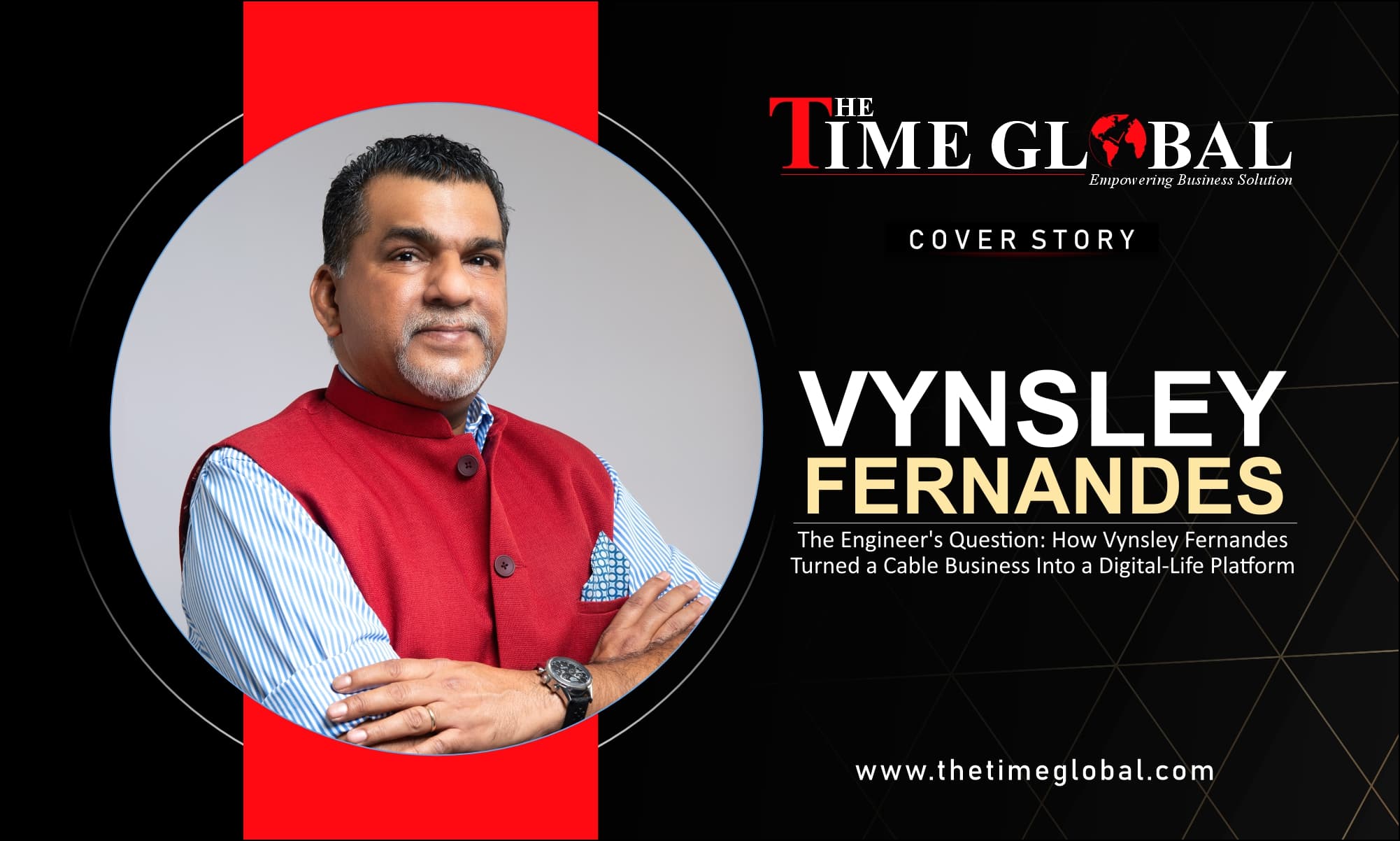
The Engineer's Question: How Vynsley Fernandes Turned a Cable Business Into a Digital-Life Platform
Key Takeaways
- Reframing media distribution as an engineering and logistics enterprise carrying entertainment along with it.
- Shifting company culture from defending three disconnected accounts (cable, HITS, broadband) to nurturing a single household relationship.
- Scaling OneOTT into a premier private ISP through 15,000+ local franchise partners on an asset-light, partnership-led model.
- Deploying predictive AI analytics in Mumbai-Thane-Navi Mumbai to boost network uptime by over 50%.
- Transitioning from triple-play provider to a comprehensive digital-life platform by 2030, supported by public-private digital inclusion like Project GANGA.
Ask Vynsley Fernandes what drew him into media three decades ago, and he corrects the premise before answering it. It was never the pull of entertainment. It was a harder, quieter question: how do you deliver a signal, reliably and at scale, into millions of living rooms scattered across a subcontinent as vast and unevenly connected as India? That question followed him through News Corporation, Star India, TATA Sky, 9X Media and CastleMedia, sharpening into conviction during the DTH rollout that would eventually become TATA Play. "This was never simply a content business dressed in a technologist's coat," he says. "It was, at its very foundation, an engineering and logistics enterprise that happened to carry entertainment along with it." That reframing has quietly governed every decision since.
It is a striking admission from someone who studied mass communications, not engineering. Yet he treats the mismatch as an asset rather than a gap. "A grounding in mass communications teaches you, above all else, to begin with the audience," he says, "to ask first what a viewer feels and needs, and only then to reach backward into the machinery that makes that experience possible." His technical teams tell him what is possible. His own training, he says, tells him what is actually worth building.
Five Years Watching From Outside
Fernandes did not arrive at the Hinduja Group in a single stride. At CastleMedia, a technology consulting venture he helped build; he spent five years consulting on the HITS launch before joining full-time in 2018 — a runway he characterises less as hesitation than as due diligence. What struck him, observing from outside, was the group's genuine appetite for long-term commitment, and the discipline behind the HITS build itself: no shortcuts taken that might have compromised its integrity. By the time the full-time offer arrived, he says, it was not a leap of faith. It was the natural continuation of something he had already watched being built with unusual care.
One Household, Not Three Accounts
The business Fernandes inherited in 2018 was not, in truth, a single business. It was three: cable television, HITS, and a nascent broadband effort, each optimising for its own narrow metrics, each blind to the household it ultimately served. He is direct about which fix mattered most. Not a cost-cutting measure. A cultural one.
"The fix that mattered more than any single cost-cutting measure was cultural before it was operational: persuading every team to see one customer's television, broadband, and entertainment consumption as a single relationship to be nurtured, rather than three disconnected accounts to be separately defended."
He is equally direct in crediting the network that made that shift possible on the ground: thousands of franchise partners across India, responsible for the household connection itself and the relationship that followed from it. Once that mindset took root, he says, the bundling economics and ARPU gains followed of their own accord.
The Cost of Staying Together
Running digital cable, HITS, and broadband under one roof is not the leanest way to operate any single one of those businesses, and Fernandes does not pretend otherwise. A pure-play broadband operator would appear tidier on paper. The cost, as he frames it, is one of coordination: capital stretched across markedly different infrastructure, and teams built for satellite and cable now required to think fluently in broadband as well.
What that coordination purchases, in his view, is a unified distribution backbone capable of offering a household everything from video to broadband to smart connectivity — precisely the bundling economics now drawing customers toward premium upgrades. He resists just as firmly the notion that HITS and satellite cable represent a slowly dying business kept alive by scale. Customer data, he says, tells the opposite story: households bundled with video are migrating steadily toward premium broadband speeds. "The old infrastructure is what makes the new business affordable to scale," he says, "and that is a durability few outsiders appreciate."
An Asset-Light Bet
OneOTT's growth into one of India's largest private ISPs looked, from the outside, like diversification for its own sake. Fernandes says the actual signal was narrower and considerably more specific: some fifteen thousand franchise partners and a substantial video-subscriber base were already in place, ready to be upsold into broadband without the company needing to outspend telecom giants on raw infrastructure. It was, in other words, the extension of a genuine strength, rather than the pursuit of a fashionable adjacency.
He is candid that it did not feel certain at the time. Treating broadband as a genuine pillar of growth, rather than a modest addition to the core video business, meant asking a cable-and-satellite organisation to step into an arena dominated by telecom giants with far deeper pockets. "There were quiet moments when I wondered whether we had over-reached," he admits. Partnership over a capital arms race is what kept the wager from going the other way.
What Happens When the Box Disappears
Ask Fernandes what NXTDIGITAL sells a mobile-first, AI-curated streaming generation that never touches a set-top box, and his answer bypasses hardware altogether. What remains, he says, is the invisible architecture beneath the experience: high-speed connectivity, aggregated access to the streaming applications that generation already favours, and, increasingly, the broader fabric of a connected home — smart Wi-Fi, security, and building connectivity.
The ambition over the next five years is a complete repositioning — from triple-play provider to what he terms a "digital-life platform," one underwriting entertainment, remote work, education, and modern living itself – leveraging Hinduja Global Solutions’ vast “intelligent experiences” product portfolio. The box may well vanish. The network and the bundle around it, in his view, become only more essential.
AI in Practice, Not on a Slide
Pressed for a concrete instance of artificial intelligence altering a real decision this year, rather than a strategy-deck abstraction, Fernandes points to a specific zone: Mumbai–Thane–Navi Mumbai, where predictive network analytics moved the company from reacting to outages to anticipating them before a customer ever noticed. Network uptime improved by more than fifty per cent. "This was not a slide in a strategy deck," he says. "It was a concrete allocation of resources, made because the data told us, with real precision, precisely where failures were about to occur."
Moving a Legacy Team With Revenue, Not Rhetoric
Persuading cable and satellite teams to embrace a "digital" identity overnight rarely succeeds through language alone, and Fernandes did not rely on it. Initiatives such as NXT Sangram, which trained franchise partners in emerging technologies, new selling techniques, and the mechanics of bundling, existed as much to demonstrate that the new business actually worked as to impart the skills themselves.
Once the people responsible for the physical network witnessed, firsthand, the upside of selling broadband alongside cable, he says the cultural shift ceased to require any persuasion at all. It simply took care of itself.
Phygital
Fernandes has a pointed observation about outsiders arriving from mature markets. They assume India will leapfrog gracefully into a fully digital, self-service model, in the manner of other categories elsewhere. He does not believe it will, not for a considerable while yet. Roughly sixty per cent of the customer base sits in Tier-2, Tier-3, and rural markets, where a trusted local partner arriving at the doorstep still carries more weight than any application ever could.
"We have a phrase for that critical parameter: phygital. Delivering digital may be the driver, but physical presence remains essential."
Regulation compounds that friction. Shifting interconnect and tariff rules force regular renegotiation of carriage arrangements and ARPU assumptions across every market the company serves — a cost that has less to do with any single misjudgement than with the sheer pace of change, measured against the considerably longer horizon that infrastructure of this scale genuinely demands.
Redefining Success
Two items now occupy the top of Fernandes's agenda that had no place on it in 2018. The first reflects HGS’ global mantra; artificial intelligence woven directly into network operations — predictive analytics, churn modelling, and intelligent plan recommendations — now central to how the business runs from day to day. The second is public-private digital-inclusion work, exemplified by Project GANGA or “Government Assisted Network for Growth and Advancement” with the Government of Uttar Pradesh, which treats last-mile connectivity not as a corporate rollout but as something built alongside local youth driving their own region's digital-inclusion agenda.
That same forward-looking posture shapes how he speaks of the one figure a rival might read as decline. Should NXTDIGITAL's cable and satellite business shrink over the next decade even as the wider group grows, Fernandes calls that success, not failure — provided households are migrating upward into broadband and digital services the company itself owns, rather than drifting to a competitor. "Cable and satellite built the foundation and lent gravity for this business," he says. "Should that legacy business recede as the wider group flourishes, I will regard it not as decline, but as the plan working exactly as it was always intended to."
By 2030, he wants the very idea of a "triple-play" connection to feel almost quaint — replaced by a single network quietly running a household's entertainment, work, education, and smart-home needs, without anyone having to give it a second thought. The connectivity, content, and digital-services layers are already being built. What remains, in his own framing, is ensuring they truly converge, rather than merely sitting side by side under one brand.