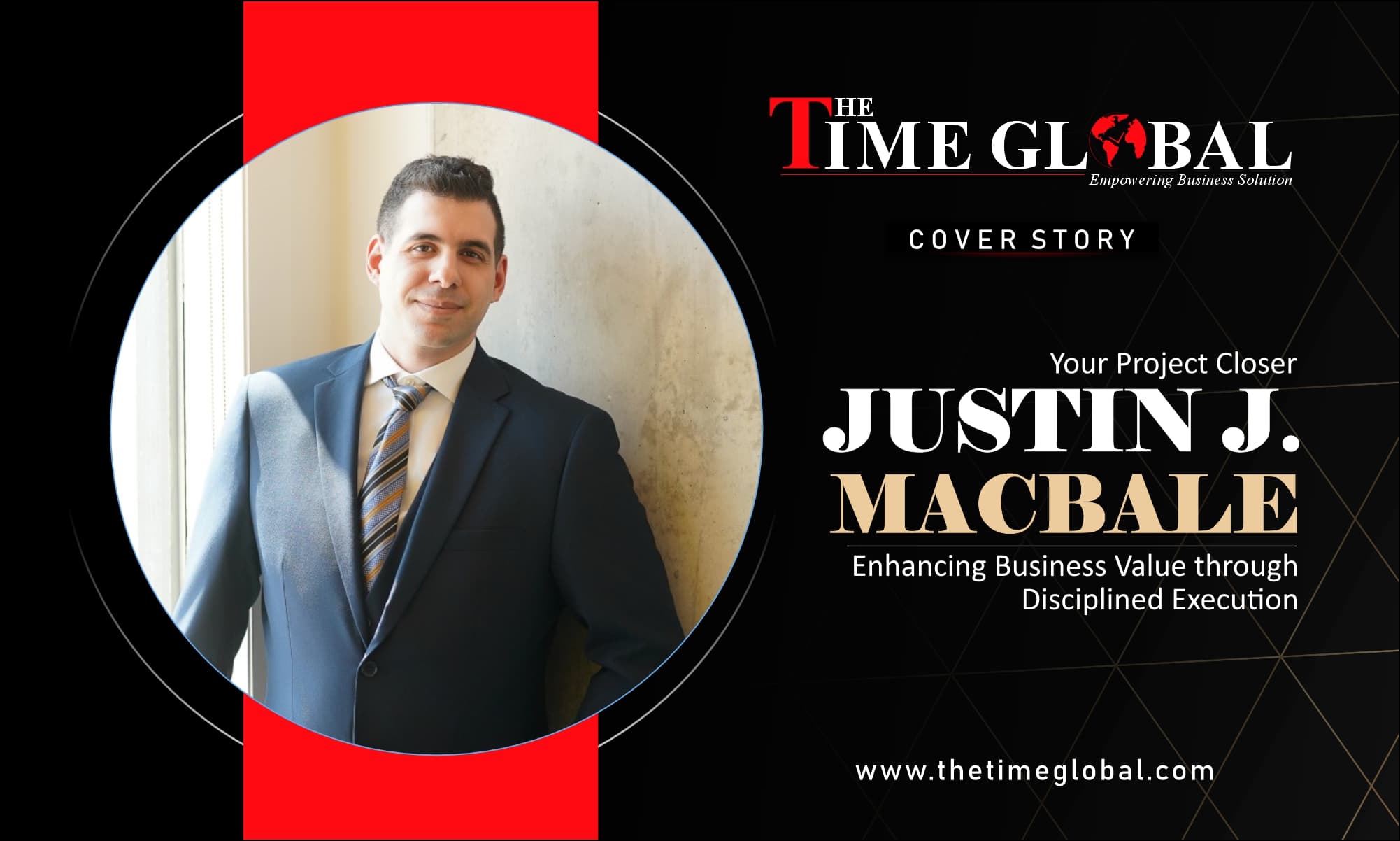
Your Project Closer: Justin J. MacBale on Enhancing Business Value Through Disciplined Execution
Key Takeaways
- Projects represent high-stakes battles for an organisation's future rather than mere task checklists or static status reports.
- Project managers must evolve from administrative task drivers into credible business advocates who protect intended business value capture.
- Successful delivery across complex $600M+ initiatives hinges on the co-creation of robust strategy and governance, coupled with stakeholder maturity.
- Sustainable leadership requires mastery across three neglected lenses: deep business acumen, big picture systems thinking, and political sensitivity.
- Through Pragintion PM and PM Career Growth, MacBale champions disciplined execution, timely risk curation, and in-person trust building.
For Justin J. MacBale, a project is never a mere checklist or a static collection of status reports. In his view, every initiative represents a high-stakes battle for an organisation's future. Within corporate environments where digital shifts occur overnight and high-velocity mergers can either cement or shatter a legacy, MacBale has consistently acted as the stabilising force that prevents even the most established enterprise projects from stumbling.
His project management career started in CPG growth development projects, moved through ERP implementations and operational improvement, and extended into product development and M&A post-merger integrations.
From an external perspective, many transformations appear deceptive in their simplicity, like scaling an enterprise ERP rollout from a pilot phase to a full-scale operational engine. To the public, it looks like lift and shift. Internally, the project has hit a wall of what he calls computational debt, where spiralling inference costs and uncleaned data silos drain budgets and cause key stakeholders to delay just weeks before the deadline.
Or it might be integrating real-time sensor intelligence into a legacy manufacturing supply chain. On paper, it's a smart-factory upgrade. In an actual sense, it's a six-month deadlock in which mismatched protocols and fragmented reporting tools have paralysed the factory floor, turning a multi-million-dollar investment into a source of executive frustration.
Critical projects get stalled for long periods, and the pressures on an organisation become unbearable enough that someone is needed who can bring the project out of the mess: a capable leader able to deliver reliable and authentic stability. That ability to dissect complexity, silence the confusion, and execute a surgical fix is precisely why MacBale has earned his reputation as...
'The Closer'
The interesting thing to note is that this title is not something MacBale created. It was bestowed on him, given by the clients he served and partnered with.
After making an impression on one client during a carveout, raising the questions and risks that needed to be raised, the client stated he was there to close them, and the project, and began referring to him as The Closer. Given his tumultuous career in project management, the epithet suited him quite well.
MacBale has a history of coming into troubled projects that were either behind schedule or had lost the business's trust in the project manager he replaced. In some cases, the old project manager's work was taken up by the business itself to ensure quality and completion, leaving a rift between the business and the project management team.
When MacBale rescues these projects, he focuses on fixing that rift and realigning project strategy and governance toward the intended business value. He works to remove points of friction and become a trusted advisor to the business, which increases communication and lets him be more proactive in addressing risks and issues on critical projects.
The Gap
MacBale has observed that organisations tend to have project managers who don't understand the business or the business functions within a company. That, in his view, is one of the biggest gaps limiting a project manager's ability to protect intended business value realisation as defined by the project sponsor.
If a project manager doesn't understand how business functions work together, the technology that enables them, and the underlying business workflows, how can they identify and help mitigate risks and issues in a project? Some organisations, he notes, fail to recognise that a project manager tends to have the highest visibility into a project and can become the eyes and ears for a project sponsor, giving ample time to raise concerns that could otherwise threaten long-term value.
Sometimes you need to stop the bleeding before you can diagnose or make changes, particularly in situations that touch a customer or vendor and directly affect the business's profitability or reputation.
MacBale works to understand and earn the trust of stakeholders, gradually introducing suggestions or recommendations while emphasising that he understands their larger concerns and their business. Task execution remains part of the path to project completion, but he also builds a narrative and reputation around becoming a focal point for the business and the project sponsor. Over time, that shift can change how people view the project manager role, from a task driver into someone actively advocating for project success.
The True Value of Project Management
MacBale ensures that business value is not just created but also protected and defended throughout a project.
"One thing to note is that the project manager is not responsible for, or has the authority to create, the intended business value directly. But they are curators of timely information. Information is key to help identify and mitigate risks and issues that threaten the intended business value capture."
Project managers, in his framing, must work with subject matter experts and other stakeholders to create understanding and recommendations for business decision-makers to act on. The ability to both proactively and urgently raise the right information at the appropriate level of the organisation is key to protecting that business value.
Stakeholder Patterns That Prevail Across Industries
With cross-industry experience, MacBale quickly diagnoses operational realities and stakeholder dynamics in new environments. According to him, the irony is that stakeholder dynamics tend to behave similarly across industries. There are those who feel underappreciated or left out, those exhausted by a lack of progress or realised outcomes, those who thrive in the current status quo, and those who are generally content because they have other priorities to deal with.
People like to be heard, not through platitudes or superficial discussion, but genuinely understood. A project manager who grasps that internal and external stakeholders carry both short-term and long-term priorities will navigate ambiguity and find common ground faster than their counterparts.
Key Leadership Mindset Shifts
MacBale insists that certain leadership mindset shifts are essential for organisations navigating continuous transformation and uncertainty. Project leaders need to understand a few core concepts, but primarily need both a short-term and a long-term read on business operational readiness.
"Initial project approvals and setup are built on a set of assumptions, and those assumptions can be faulty or change over time. Therefore, the scope must be willing to adapt as needed as well."
A business needs to keep operating to generate the revenue and profit that sustains project investment, which means projects need to reduce or limit any operational outages or impact on daily operations. Project plans, communications, and decision-making should be geared toward making sure relevant stakeholders have the training and capabilities to operate under the future state.
The second factor MacBale emphasises is that scope changes shouldn't be viewed as inherently good or bad in isolation. Some scope changes identified after the fact will actually help protect or maximise the intended business value. It's the project manager's responsibility to act in good faith and present those decisions to the decision-makers, rather than arbitrarily dismissing something as out of scope.
The Criteria for Successful Projects
Having led transformations exceeding six hundred million dollars in value, MacBale points to two things that distinguish successful execution from controlled failure in large-scale initiatives: the co-creation of a robust strategy and governance, and the maturity and capabilities of the project stakeholders themselves.
On the first, a clearly defined project strategy that aligns toward the intended value to be realised, and the exit criteria, is key to building the guardrails that frame project success. You also want a decision-making framework tied to that intended business value, covering who the decision-makers are, the escalation paths, and the prioritisation rubric guiding decisions. The idea is to co-create that framework with key stakeholders, so they're bought in and can provide insight into how the organisation actually operates, building it ahead of time so it's ready to use during moments of crisis or business context shifts, reducing decision-making time through logic and data rather than improvisation.
"I have seen organisations that lack maturity in their processes or their skills within their teams that can cripple execution on projects."
Knowing the skills and capabilities needed to realise a plan, and having contingencies ready for gaps, is key. Sometimes it falls on the project manager to help develop fundamental understanding around concepts like requirements documentation, approval sign-offs, and testing. More often than not, less mature project teams don't fully understand how their actions can directly or indirectly impact the organisation, and their own careers.
Advice for the Future
As someone recognised for closing high-stakes initiatives, MacBale's advice to emerging leaders aiming to build credibility and long-term influence is straightforward.
"Say what you mean and do what you say."
It sounds simple, yet so many people either overpromise or lack the ability to follow through, especially when rescuing an existing project, where tensions run high and tolerance runs low. Being able to speak credibly about capacity and commitments, and then actually act on them, is a powerful way to build trust quickly. The other piece of advice is to keep your ego at the door. A project manager's role is to help facilitate intended business value capture. No task is too small to provide value, and reducing points of friction throughout the process pays dividends.
Pragintion PM: Grounded in Pragmatism, Fueled by Intent, Focused on Value
MacBale's approach is built on more than fifteen years of experience leading massive digital shifts and merger integrations worth over six hundred million dollars. He believes traditional project management education often fails because it focuses on tracking tasks while ignoring how real value is created and protected.
He doesn't treat delivery as a mere exercise. He treats it as an instrument of business survival. Whether working as a senior manager or stepping in as a fractional leader through his firm, Pragintion PM, his goal is always to restore alignment and reassert the authority needed to cross the finish line.
Pragintion PM focuses on business advocacy, something MacBale considers critical because projects are a mechanism to help a business survive, and because current project management practice, in his view, doesn't focus on business value enough. Just over two years ago, he began discussing publicly how important it was for project managers to understand business functions and operations, arguing that projects exist to maximise intended, sustained business value capture rather than simply produce deliverables. He was mocked in the social media space at the time, with critics claiming he didn't know what he was talking about. Project management training and coaching has since moved to redefine projects as activities meant to realise business value.
The Partnership
MacBale understands that the gap in the industry isn't just about systems. It's about people. That realisation led him to co-found PM Career Growth with Elizabeth Dworkin, a project management learning platform dedicated to developing project professionals who can act as credible business advocates, seen as strategic leaders within the organisations they operate in.
"Pragintion PM, in partnership with PM Career Growth from a training and coaching side, will continue to help bridge the gap for project professionals to become business advocates rather than project methodology enthusiasts."
PM Career Growth focuses on eight lenses across the project management world, three of which MacBale wanted to highlight specifically: business acumen, big picture and systems thinking, and political sensitivity.
The Lenses
These three, he argues, aren't talked about enough by either formal project management training or coaching, and in this day and age, you cannot sustain a project management career without understanding and holding these core skills.
Business acumen is more than tracking budgets. It means fundamentally understanding how a business operates and its value streams within an organisation, that individual departments and the broader organisation both run on the concepts of profit and loss, and how business departments work together from a workflow and technological perspective to keep the business operating and generating profit to invest in future projects. It also means understanding that projects are a survival mechanism for businesses to grow or protect revenue, control or minimise costs, reduce or mitigate risk and liability, and increase or change market position.
Big picture and systems thinking builds on that business acumen, understanding the ecosystem of a business and the causal relationships among individuals and the sum of their parts. Seeing how everything operates together, and how changing one element impacts the upstream and downstream elements of a business or function, is key.
Political sensitivity, MacBale notes, is a personal favourite of his, and the final of the three lenses. Project managers must manage the optics and political elements within a project. It doesn't matter if you've done a great job within a team if the broader stakeholders and business sponsors don't know or agree with that conclusion. Projects operate within an organisation; they inherit its history, culture, politics, and procedures, and each person involved is looking to help their group, department, or themselves progress. A project manager needs to understand that the power of timing and communication delivery can make or break their optics on a project.
The Dynamics
Above all else, a project manager will be removed if no one wants to work with them, regardless of the outcomes they can help achieve. MacBale believes a project manager must become a trusted advisor who provides insights and recommendations. Project leaders who have executive trust and confidence get more timely feedback, are brought into larger conversations, and gain more opportunities than those focused purely on project operations.
Project leaders who build credibility with executive leadership demonstrate that they know how to drive results while understanding the larger dynamics of an organisation, business operations, politics, and optics included. That lets executive leaders reduce the energy and already-limited time they spend each day managing their project investment.
Rescuing Distressed Projects
One critical principle MacBale uses when stepping in to restore alignment and momentum is shared understanding: having one-to-one conversations and genuinely listening. Listening to different perspectives on priorities, concerns, problems, and viewpoints matters more than assuming you already know the picture from documents or the grapevine. He makes a point of reserving his initial knee-jerk reaction to fix things, and instead validates the problem statements first.
The complication lies in where you are in the project lifecycle when you come in to help. Sometimes you need to stop the bleeding before you can diagnose or make changes, especially in situations that touch a customer or vendor and directly affect the business's profitability or reputation. That ability can psychologically change how people view the project manager role, from a task driver to someone who is advocating for project success.