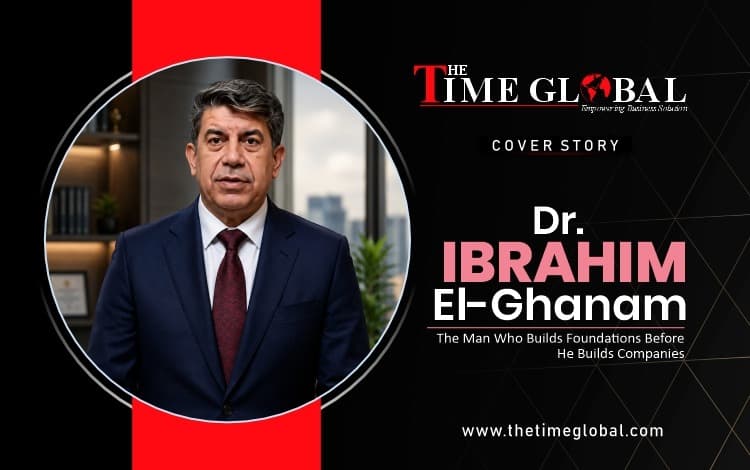
Dr. Ibrahim El-Ghanam: The Man Who Builds Foundations Before He Builds Companies
Key Takeaways
- Foundations Over Speed: True enterprise resilience requires building strong financial governance and operational structures before attempting to scale.
- The Five-Layer Startup Test: Evaluating ideas across core problem, supply chain, production, distribution, and genuine market demand.
- Mentorship That Builds Judgment: True guidance builds founder independence and critical thinking rather than supplying easy answers.
- AI vs Human Instinct: AI is an efficiency tool for research and scenario modeling, but human judgment, local context, and ethics remain irreplaceable.
- The El-Mobadara Model & Entrepreneurship Encyclopedia: Creating permanent, accessible libraries of wisdom and practical systems to support SMEs nationwide.
There is a lesson that construction teaches which no business school ever quite manages to replicate: nothing standing above the ground means anything if what lies beneath it is weak. Dr. Ibrahim El-Ghanam learned that lesson decades before he ever used the word “entrepreneurship” to describe his life’s work. Managing large infrastructure projects through the 1980s and 1990s, he watched capable, intelligent people fail again and again not because they lacked talent, but because they lacked structure, planning, and knowledge suited to the ground they were actually standing on. That single observation, repeated across enough projects and enough years, would eventually become the foundation of an entirely different kind of career.
Today, as Chairman of the Board of Directors of Reyada Academy for Leadership and Entrepreneurship Development and as the mind behind the widely followed Entrepreneurship Encyclopedia, Dr. El-Ghanam occupies a rare position in the world of business advisory—trusted enough by central bankers to lecture inside the Egyptian Banking Institute and plain-spoken enough to be followed by first-time founders who have never set foot inside a bank. It is a duality that defines everything he has built.
From Blueprints to a Multiplier Effect
The defining moment of Dr. El-Ghanam’s career did not arrive in a boardroom. It arrived in 2000, when he took charge of the SMEDUP program in Upper Egypt—an initiative that would go on to support thousands of small enterprises across the region. Among them were a simple tailor, a farmer, and a young graduate, each of whom, with the right structure and practical knowledge, built businesses stable enough to employ their neighbors and lift their own families out of uncertainty.
It was there that he arrived at the conviction that has anchored everything since: that sharing practical, tested knowledge is not simply teaching—it is a multiplier, capable of transforming entire communities far beyond the individual founder in front of him. That conviction, carried forward, would eventually become the Entrepreneurship Encyclopedia itself.
> "I realized then that sharing practical, tested knowledge was not just teaching—it was a multiplier that could transform entire communities."
Built for the Region, Not Imported Into It
Reyada Academy was founded to answer a need Dr. El-Ghanam saw clearly and consistently: structured, practice-grounded leadership and enterprise development built for regional realities, rather than untested foreign models layered awkwardly on top of them. That founding vision—to build leaders and enterprises that last—has not changed. What has changed is its scope.
As the entrepreneurship landscape has evolved under the pressure of digital transformation, new categories of risk, and a growing demand for inclusive growth, Reyada Academy has expanded alongside it—integrating emerging fields such as artificial intelligence, regenerative business, and early warning systems for business failure, while holding firm to its original commitment to accessibility and practical impact.
What the Central Bank Taught Him About Risk and Survival
Few entrepreneurship educators have spent meaningful time inside a central bank. Dr. El-Ghanam’s years as a consultant and lecturer of strategies and entrepreneurship at the Egyptian Banking Institute of the Central Bank of Egypt gave him a dual perspective most founders never get: seeing, on one side, precisely how financial systems measure risk and, on the other, how often founders overlook those same realities entirely.
The lesson that stayed with him is a deceptively simple one: most businesses do not fail because they lack sales. They fail because they run out of cash, underestimate costs, or confuse revenue with profit.
> "Discipline is not bureaucracy—it is survival."
Risk is not something to be avoided but something to be understood, measured, and prepared for from the very first decision a founder makes.
The Five-Layer Test Every Founder Should Run
Ask Dr. El-Ghanam how he actually evaluates a startup idea, and he will not offer vague encouragement. He will walk you through five interconnected layers:
1. **The Core Idea:** Whether it solves a real problem or eases genuine pain. 2. **The Supply Chain:** Whether inputs can be secured reliably and affordably. 3. **Production:** Whether the solution can be made consistently at the right cost. 4. **Distribution:** Whether it can reach the people who need it efficiently. 5. **The Market Itself:** Whether there is real willingness to pay and whether the segment is large enough to matter.
In his experience, it is the fourth and fifth layers—distribution and genuine market demand—that founders consistently underestimate. Too many begin with a product they want to sell, rather than a need people are already paying to solve, and assume customers will simply find them, without ever mapping how, where, and at what cost that discovery is actually meant to happen.
> "Start with the problem, not the product. Do not ask, 'What can I sell?' — ask, 'What does the world need me to fix?'"
Mentorship That Builds Judgment, Not Dependency
Dr. El-Ghanam draws a sharp line between two kinds of mentorship that are too often confused with one another. True mentorship, in his view, does not hand a founder ready-made solutions—it helps them see their own blind spots, asking questions that clarify values, expose assumptions, and test logic.
> "Mentorship that only gives answers creates dependency; mentorship that builds judgment creates independence."
He is equally direct about how founders should evaluate whether a mentor relationship is genuinely valuable, rather than simply prestigious: * Does this person understand your specific context, not just global trends? * Do they have real time to engage, not merely a name to lend? * Does their advice actually apply to the stage and scale you are at right now?
Chasing celebrity mentors, he warns, often leaves a founder with a title but no real guidance—the most valuable mentor is someone who has walked a similar path, understands your constraints, and prioritizes your growth over their own visibility.
Reading the Warning Signs Before the Product Fails
Long before a product fails, Dr. El-Ghanam argues, the founding team’s mindset usually fails first—and the signs are visible for anyone willing to look: * A refusal to accept feedback. * The insistence that "this is how we’ve always done it." * Blaming external factors instead of reviewing internal choices. * Prioritising image over substance.
Like Blockbuster, he notes, many teams become attached to their own success story rather than the changing reality around them. Growth mindset, in his framing, is not optimism—it is the humility to keep learning, adjusting, and seeing what is actually there.
That same clear-eyed logic shapes his thinking about channel strategy. Every channel—online, retail, direct sales, partnerships—carries its own audience, costs, and expectations.
> "Many great products fail not because they are bad, but because they were placed where they were never wanted."
Meeting Founders, Employees, and Students Where They Are
Dr. El-Ghanam’s approach to advising shifts deliberately depending on who is in front of him: * **For Students:** The focus is on foundations—values, curiosity, and how to think, not merely what to know. * **For Employees:** It is ownership, contribution, and the ability to see beyond one’s role. * **For Entrepreneurs:** It is reality itself: risk, cash flow, trade-offs, and the discipline to say no to what does not serve the founder’s core purpose.
The goal, in every case, is the same: to meet people exactly where they are and give them precisely what they need to take the next step forward.
> "You do not need a position to help someone think more clearly, make better choices, or build confidence."
A Region of Untapped Potential
Asked to characterize the entrepreneurship ecosystem across Egypt and the wider region, Dr. El-Ghanam describes something vibrant, resilient, and full of untapped potential—but also layered, with real gaps in practical support, context-specific knowledge, and risk awareness. Thousands of enterprises launch each year, he notes, yet many struggle to scale sustainably.
The misunderstanding he sees most often among international observers is a familiar one: the direct application of Western models, assuming the same conditions, resources, and market dynamics apply universally. What that view consistently misses, he argues, is that success in the region requires genuine adaptation to local culture, cost structures, and economic realities—not simply importing ideas that happened to work somewhere else.
Where AI Helps — and Where Judgment Still Wins
On artificial intelligence, Dr. El-Ghanam holds a position that is neither utopian nor dismissive. AI, in his view, is a genuinely powerful tool for research, analysis, testing scenarios, and organizing knowledge—capable of making the frameworks he teaches faster, more accessible, and more detailed. But it cannot replace three things: 1. Deep understanding of local context 2. Moral and ethical judgment 3. The courage to make hard choices when the data is incomplete
> "AI can inform — it cannot decide what matters most to you."
The Cost of Growth Without Focus
Few phrases in Dr. El-Ghanam’s vocabulary are delivered with more conviction than his warning against unfocused growth. It drains resources, dilutes reputation, spreads a team too thin, and often leads to collapse—a founder may grow fast, he says, but they will not grow strong.
> "Focus is not limitation — it is leverage."
His advice on what to say no to is equally direct: any opportunity that does not align with a founder’s core purpose, that requires skills or resources they do not have, or that moves them away from the specific problem they set out to solve.
That same discipline extends into the financial gaps he sees most often in early-stage founders. Most understand sales, he observes, but far fewer truly understand cash flow, working capital, or the difference between revenue and profit. Money coming in feels like success until suppliers, salaries, and unexpected costs reveal otherwise. It is, in his words, the quiet gap that sinks otherwise promising businesses.
What Separates Builders Who Last
Across the thousands of founders he has taught, mentored, and observed, Dr. El-Ghanam has arrived at a clear pattern separating those who build something lasting from those who build something merely impressive: * Prioritize foundations over speed * Solve real problems over chasing trends * Adapt without losing core values * Measure success by impact and endurance rather than size or visibility * Treat problems as feedback rather than failure, learning, adjusting, and building one steady step at a time
The Next Chapter for Reyada Academy
Reyada Academy’s next phase is already underway. Dr. El-Ghanam is expanding specialized programs in regenerative business, digital transformation, and early risk detection while building new partnerships with universities, banks, and civil society organizations to take the **El-Mobadara Model** nationwide and to integrate the **Entrepreneurship Encyclopedia** directly into formal training curricula across the region.
Leadership Without a Title & Lasting Legacy
Dr. El-Ghanam often returns to a single idea when asked what leadership ultimately means to him: that leadership is not authority; it is service. No position is required to help someone think more clearly, make a better choice, or build genuine confidence—a belief that has shaped his entire career.
> "I want to leave behind a replicable system for supporting SMEs, a generation of leaders who carry this work forward, and the Entrepreneurship Encyclopedia—a permanent library of wisdom that serves generations to come."
Frequently Asked Questions
Who is Dr. Ibrahim El-Ghanam?
Dr. Ibrahim El-Ghanam is Chairman of the Board of Directors of Reyada Academy for Leadership and Entrepreneurship Development, Founder of the Entrepreneurship Encyclopedia, and former Strategy & Entrepreneurship Lecturer at the Egyptian Banking Institute (Central Bank of Egypt).
What is Dr. El-Ghanam's Five-Layer Evaluation Test for startups?
The five layers are: Core Idea, Supply Chain, Production, Distribution, and Market Demand. He emphasizes that distribution and genuine market demand are the two areas founders most consistently underestimate.
How does Dr. El-Ghanam define true mentorship?
He defines true mentorship as guidance that builds founder judgment and independence by asking probing questions, rather than supplying ready-made answers that create dependency.
What is Dr. El-Ghanam's perspective on AI in entrepreneurship?
AI can inform decisions by organizing data, analyzing scenarios, and accelerating research, but it cannot replace human moral judgment, local context understanding, or entrepreneurial instinct.