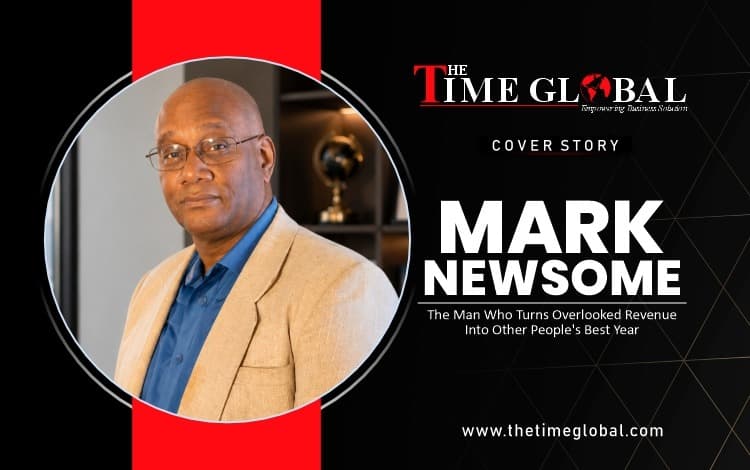
Mark Newsome: The Man Who Turns Overlooked Revenue Into Other People’s Best Year
Key Takeaways
- Joint Venture Architecture: Eliminating customer acquisition costs through strategic partnerships with non-competing local vendors.
- Owned Assets Over Rented Media: Why email lists deliver an average ROI of $36-$45 per dollar spent while social media reaches only 2-4% organically.
- The Discount Trap: Reserving pricing perks for high-value behaviors (referrals, opt-ins, testimonials) rather than eroding margins with broad discounts.
- Agentic Commerce Preparation: Structuring clean data, personalization, and customer records for AI assistants making purchase decisions.
- Fast Non-Dilutive Capital: Alternative funding solutions providing certified funding in 7 days or less for qualifying North American small businesses.
There is a particular kind of expertise that only reveals itself over time—not the kind earned inside a single industry or behind the safety of one reliable methodology, but the kind forged through decades of navigating the unglamorous, high-stakes reality of independent retail survival. Mark Newsome is that kind of expert. And in a business landscape that has spent the better part of a decade celebrating venture-backed disruption, algorithmic platforms, and billion-dollar brand plays, he has quietly, stubbornly, and extraordinarily effectively been doing something that most marketing strategists stopped paying attention to long ago: teaching independently owned businesses how to grow without spending more than they earn.
His entry point into the world of entrepreneurship and revenue strategy was the multi-billion dollar, privately held, real estate-secured notes industry, a world far removed from the retail floors and service counters he would later come to know intimately. But it was that first chapter, and more specifically, the act of authoring his own 160-page self-published workbook, “How To Profit Through Discounted Notes,” that cracked something open in him. Not confidence, exactly, though that followed. What it cracked open was clarity: a sharp, uncomfortable awareness of how much he did not yet understand about what it truly takes to sell, market, and build something that lasts.
That awareness, rather than deflating him, became the engine of everything that followed. A second workbook. Decades of direct work with retailers and service providers. A 29-page special report on the ten most common marketing mistakes small business owners make. A philosophy of strategy that is equal parts practical, unconventional, and relentlessly focused on the bottom line. And a perspective on retail revenue growth that, in 2026, feels less like wisdom from the margins and more like a blueprint the entire independent retail sector urgently needs.
The Education That Comes After the First Book
Most people who write a book about business do so to demonstrate what they know. Mark Newsome wrote his first book and discovered, with startling clarity, what he didn’t. That distinction matters more than it might initially appear, because it speaks to the foundation on which every subsequent insight in his career has been built: a genuine, ongoing willingness to be taught by the gap between what he assumed and what was actually true.
“How To Profit Through Discounted Notes,” still retailing at $69 against a $19 print cost—a gap that itself tells you something about Mark’s understanding of perceived value—opened his eyes, as he puts it, to the reality of what being a real profit-producing entrepreneur actually required. Not the theory of it. Not the aspiration. The actual, daily, often uncomfortable work of understanding sales, understanding marketing, and understanding that most of what independent business owners think they know about growing revenue is either incomplete or entirely wrong.
That humility deployed not as self-deprecation but as strategic discipline runs through everything he has built since. It is why his second workbook, “How To Make A Marketable Difference!!,” focused not on what retailers should do, but on the 34 proven marketing methods they were already using that were costing them money. It is why his 29-page special report on marketing mistakes reads less like a consultant’s checklist and more like a conversation with someone who has watched thousands of businesses leave money on the table and finally decided to name, precisely, where it was going.
The through-line of his career is not a single industry or a single tactic. It is a question: where is the revenue that is already available to this business, and why isn’t it being captured? That question, asked consistently and answered honestly, has made him one of the most practically useful voices in independent retail strategy today.
---
The Email Marketing Paradox: The Channel Everyone Ignores and No One Should
If there is a single conviction at the center of Mark Newsome’s commercial philosophy, it is this: independently owned retailers are sitting on one of the most powerful, most cost-effective, most consistently proven revenue tools in the history of digital marketing—and the overwhelming majority of them refuse to use it. Not because they haven’t heard of it. Because they have convinced themselves, against all available evidence, that social media is a better bet.
His frustration with this dynamic is not abstract. It is grounded in numbers, in observed patterns, and in a direct understanding of what the decision to rely on social media actually costs an independent retailer over time. The core problem is ownership—or more precisely, the total absence of it. When a retailer builds a following on a social media platform, they are not building an audience they control. They are renting attention from a platform that has every commercial incentive to limit their organic reach and charge them for the difference. The statistics are unambiguous: organic social content typically reaches two to four percent of a page’s followers. The rest are invisible unless the retailer pays.
Email marketing, by contrast, is an asset the retailer owns outright. A subscriber list, built strategically and nurtured consistently, cannot be suspended, de-platformed, or algorithmically throttled. It is a direct line to a qualified audience, people who have actively chosen to hear from the business, and the returns on that line are measurable and consistent. Recent data continues to confirm what has been true for years: Strategically implemented email marketing returns between $36 and $45 for every $1 invested correctly. That is not a marginal advantage over social media. It is a structural one.
What makes his position on this particularly compelling is that he does not argue against technology adoption in general; quite the opposite. He is genuinely enthusiastic about the long-term possibilities that AI makes available to independent retailers. His concern is specifically about the misallocation of attention and trust: the tendency of retailers to embrace platforms that feel modern and visible while ignoring tools that are less glamorous but vastly more reliable. The email list, in his framework, is not a legacy channel. It is the foundation on which every other digital strategy should be built.
---
Joint Ventures and the Art of the Cost-Shifted Customer
One of the most persistent and expensive beliefs in independent retail is that growing the customer base requires growing the marketing budget. Mark Newsome has spent decades demonstrating, systematically and in specific business contexts, that this belief is not only wrong but is one of the primary reasons so many independently owned businesses plateau and struggle. The most sophisticated retailers he has worked with have learned something that their less successful counterparts have not: that the most expensive part of running a retail business—the cost of acquiring a new first-time customer—can be dramatically reduced, and in many cases nearly eliminated, through the strategic use of joint venture partnerships.
The logic is elegant in its simplicity. Every non-competing vendor in a retailer’s ecosystem—suppliers, service providers, neighboring businesses, and industry adjacents—has a customer base that has already been acquired, nurtured, and trusted. Those customers are, in many cases, exactly the audience the retailer wants to reach. And unlike a cold advertising campaign, an introduction through a trusted vendor carries the implicit endorsement of an existing relationship. The customer is not being interrupted. They are being invited.
> "Steadily forming various types of strategic alliances and partnerships is one of the fastest, safest, proven strategies to grow a business or service — for literally pennies on the dollar." — **Mark Newsome**
In practice, the architecture he advocates is built around reciprocity and commission. Non-directly competing local vendors periodically share carefully curated, time-sensitive offers from the retailer with their own subscriber base. In return, they earn a front-end affiliate commission on the gross revenue generated. Both parties benefit. The retailer acquires customers at a fraction of the usual cost. The vendor creates an additional revenue stream from their existing audience without adding operational complexity. And the customer receives an offer from a source they already trust.
The sophistication of this model lies in its scalability. A retailer with five active joint venture partnerships has, in effect, multiplied the reach of their marketing operation fivefold without multiplying the budget. A retailer with fifteen has built something that begins to resemble a distribution network rather than a single-location marketing effort. And the relationships built through these partnerships compound over time, creating referral channels, cross-promotional opportunities, and vendor goodwill that no paid advertising campaign can replicate.
---
The Discount Trap: Why Broad Pricing Strategies Drain the Bottom Line
There are few things Mark Newsome is more direct about than the commercial damage done by indiscriminate discounting. In an environment where independent retailers feel perpetual pressure from larger, better-financed competitors, the temptation to compete on price is both understandable and, in his view, almost always a mistake. Not because price doesn’t matter—it does—but because broad discounting strategies that give everyone a reduction end up rewarding the customers least likely to return and punishing the margins that make the business viable.
His alternative is not a loyalty program in the conventional sense, though loyalty is the outcome it produces. It is a tiered value architecture: a deliberate decision to reserve the best pricing, the most exclusive perks, and the most compelling offers for the customers who have demonstrated the behaviors the business most wants to encourage. Those who bring a friend. Those who maintain opt-in email subscriptions. Those who have provided video and written testimonials that function as living marketing assets for the business.
The commercial logic here is precise. First-time customers are expensive. The cost of reaching them, attracting them, and converting them for a single transaction is, in many cases, higher than the profit generated by that transaction. The business that chases first-time customers with broad discounts is, in effect, subsidising short-term sales volume with long-term margin erosion. The business that invests instead in deepening relationships with its highest-value existing customers is building the foundation of a genuinely sustainable revenue model.
---
The Five-Block Radius: Local Intelligence as a Growth Asset
In a landscape dominated by conversations about global reach, digital channels, and AI-powered targeting, Mark Newsome makes a point that has the quality of genuine insight: the most consistently overlooked growth opportunity available to most independently owned retailers is not online. It is within walking distance.
Within a five- to twenty-block radius of virtually any physical retail location, there are non-directly competing businesses with established customer bases and existing trust relationships and, in many cases, customers who have become inactive—not because they stopped needing what that business offers, but because they stopped being engaged by it. Those customers represent an acquisition opportunity of extraordinary quality. They are already in the area. They already have a relationship with a vendor in the retailer’s ecosystem. And they can be reactivated or introduced to a new business through an approach that costs a fraction of conventional advertising.
The mechanism he describes is one of structured, ethical incentivization. Low-cost, high-perceived-value products or services are used as the entry point—an offer compelling enough to motivate action but inexpensive enough to remain commercially rational for the retailer. The goal is not a transaction. It is the initiation of a relationship: the first visit, the first positive experience, the first reason for a customer to associate a new business with value and trust.
---
Data, Testing, and the Retailers Who Leave Money on the Table
Among the operational habits that Mark Newsome identifies as most costly to independent retailers, two stand out for their combination of simplicity and neglect: 1. The failure to A/B split test marketing materials. 2. The failure to use upsell and add-on sale strategies at the point of conversion.
Together, they represent a category of easily available revenue that most retailers, despite working extraordinarily hard, simply never capture.
> "Far too many extremely hard-working retailers leave far too much of their marketing to pure chance. They don’t A/B split test, they don’t use strategic upsells, and they’re not maximizing the profit-producing possibilities of risk reversal." — **Mark Newsome**
A/B split testing—the practice of running two versions of a headline, an email subject line, an offer structure, or a call to action simultaneously in order to determine which performs better—is not a sophisticated technical undertaking. It is a basic discipline of iterative improvement.
The upsell question is equally direct. When a customer has already made the decision to purchase, the moment immediately after that decision represents the highest-probability opportunity in the entire sales cycle to generate additional revenue. A strategically designed upsell or add-on offer at that moment can add ten to forty percent more gross profit per transaction—for literally pennies on the dollar.
---
AI, Agentic Commerce, and the Operating System Beneath the Surface
Mark Newsome is careful when discussing artificial intelligence not to overstate what he knows or predict with false precision what is coming. What he is willing to say, based on his own research and conversations with a substantial number of CEOs and founders, is that the trajectory of AI in retail is moving from tool to infrastructure.
> "AI will ultimately shift from the tool as we currently know it to the hidden operating system of the entire retail industry. Behind the scenes, supply chains will become fully autonomous and predictable." — **Mark Newsome**
What is coming is the transition to what the industry is beginning to call **agentic commerce**: an environment in which a consumer’s personal AI assistant communicates directly with a brand’s AI, negotiating, selecting, and transacting on the consumer’s behalf without human intervention at the point of purchase.
For independent retailers, if the consumer’s AI is making purchase decisions, the competitive battle is no longer being fought for the consumer’s attention. It is being fought for the AI’s assessment of value, reliability, personalization, and trust.
---
Personalization as the Non-Negotiable
In a market where large retailers can deploy machine learning to personalize at scale, the advantage belongs to businesses that invest, consistently and deliberately, in the quality of the individual customer experience.
> "When you laser-focus on under-promising and over-delivering a memorable customer experience, you don’t need a large budget to constantly deliver exceptional value." — **Mark Newsome**
The retailers who treat personalization as a luxury are failing to meet the baseline expectation of a customer who is receiving experiences tailored to their preferences across every other dimension of commercial life.
---
Strategic Alliances and Alternative Capital Access
Beyond marketing mechanics, one of the most pressing and least discussed challenges facing small business owners today is access to capital. Statistics reveal that **80 to 85 percent** of small business owners, retailers, and startups across the US and Canada are routinely rejected for commercial loans.
To bridge this gap, Mark Newsome launched an alternative funding service exclusively for qualifying retailers and small businesses in the US and Canada: * Certified funding in **7 business days or less** (vs. 6-8 weeks for traditional banks). * Funds deployed for payroll, inventory, hiring, equipment, technology, or commercial expansion. * Minimum loan requirement of $50,000 (FICO 650+ for commercial; no minimum credit score required for small business loans).
Through his platform at **www.youcanmarketonlinenow.com**, Mark continues to empower independent business owners with affordable funding solutions and sustainable marketing infrastructure.
---
The Legacy: Value Without Condition
When Mark Newsome describes what he hopes to leave behind, he reaches for a standard of personal accountability:
> "It’s my sincere hope that business owners will say I did my best to over-deliver as much value as possible, regardless of how much or how little they invested in my products or services." — **Mark Newsome**
In 2026, as the retail landscape consolidates around massive platforms, Mark Newsome’s philosophy remains a powerful blueprint: what you cannot win on budget, you win on trust.
Frequently Asked Questions
Who is Mark Newsome?
Mark Newsome is a prominent Retail Revenue Strategist, Author, and Joint Venture Architect with decades of hands-on experience advising independent retailers and small business owners on zero-cost customer acquisition, email monetization, and alternative funding.
What is Mark Newsome's Joint Venture Customer Acquisition strategy?
His strategy involves partnering with non-competing vendors to share curated offers with their existing customer base in exchange for front-end affiliate commissions, effectively multiplying marketing reach without increasing ad spend.
What is Mark Newsome's alternative funding program?
Mark Newsome offers an alternative funding service for US and Canadian small businesses and retailers, providing certified funding ($50,000+) in 7 business days or less for payroll, inventory, equipment, or expansion.