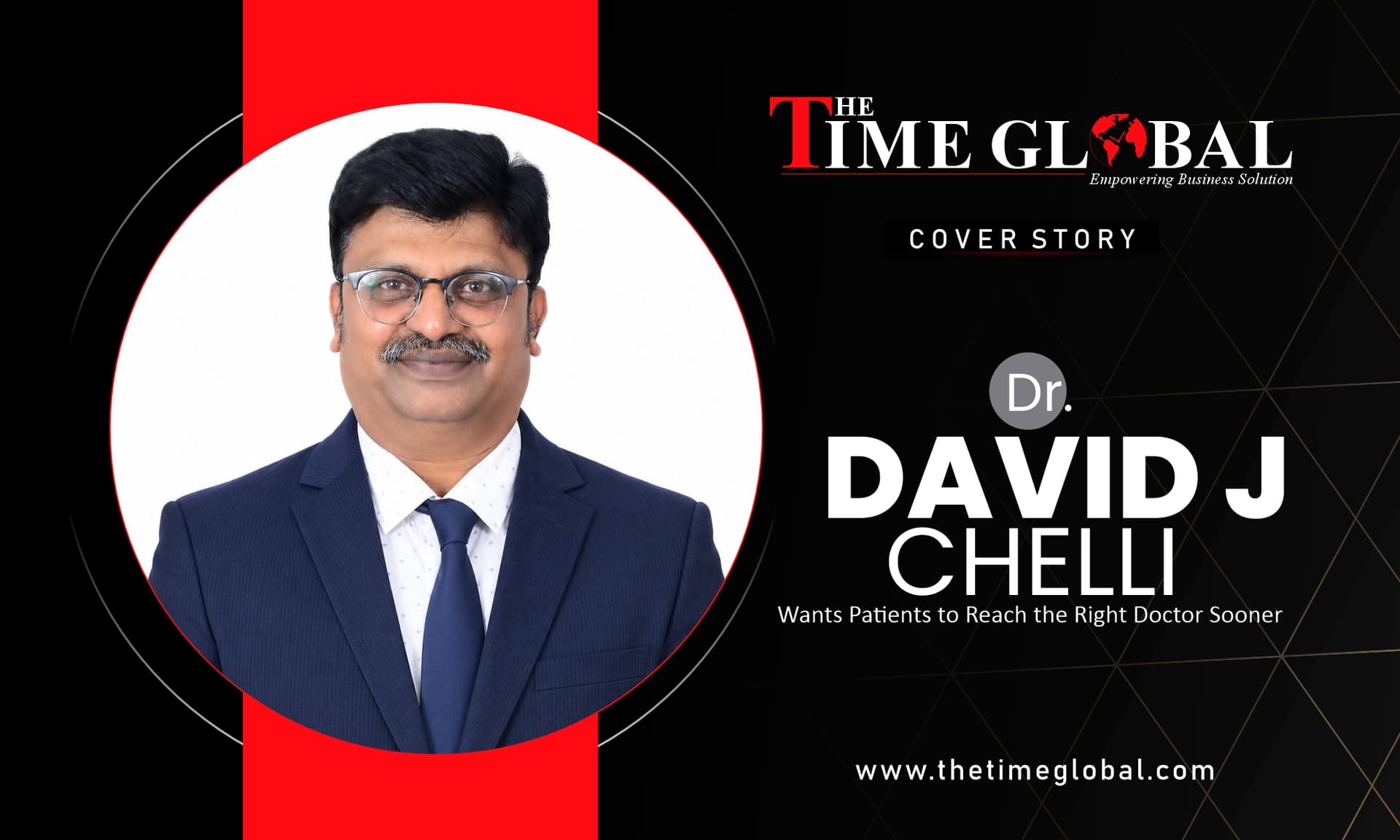
Dr. David J Chelli Wants Patients to Reach the Right Doctor Sooner
Key Takeaways
- Dr David J Chelli, MD and CEO of Jireh Cardiodigi Solutions, is building HRUDAL to bridge India's fragmented healthcare system.
- HRUDAL acts as an online supermarket for healthcare needs, bringing together 15 categories of healthcare entities including emergency response.
- Dr Chelli advocates that digital tools must support and amplify healthcare professionals rather than replace essential human bedside empathy.
- Recipient of Most Iconic Cardiologist of the Year (Kerala, 2024) and the Atal Samman for Most Renowned Healthcare Leader of South India.
After years in emergency rooms and hospital management, cardiologist Dr David J Chelli is building HRUDAL, a digital platform designed to help people navigate India’s fragmented healthcare system. His goal is straightforward: help patients find appropriate care sooner, especially when time is critical.
At Narayana Hrudayalaya, Dr Chelli recalls, a 32-year-old man was brought in after a cardiac arrest that had already lasted more than 15 minutes. The team began CPR and emergency treatment. According to Dr Chelli, the protocol being followed set a 45-minute limit, but because the patient was young, the team continued into the 50th minute. The patient’s heart began beating again.
He was taken directly to the catheterisation laboratory for emergency angioplasty. Twenty-six days later, Dr Chelli says, the patient walked home. He estimates that he has treated nearly 40 similar cases in which the outcome differed from what the team initially expected. “The end result is determined by someone else working on my shoulder,” he says. He describes his approach as both clinical and spiritual: do what is right and “follow our determined role.”
Today, Dr Chelli is Managing Director and CEO of Jireh Cardiodigi Solutions, a Mysuru-based company developing HRUDAL. The journey from the resuscitation room to a product roadmap has taken him through decades of clinical practice, a move abroad, a return to the classroom at 40 and a software-development project that ran behind schedule.
A Seat Nobody Called Easy
Medicine first captured his interest through his mother, who was a Nursing Superintendent at a large teaching hospital. He often visited her workplace as a child and became fascinated by the work of doctors and nurses. Securing a medical seat was considered difficult. “I love challenges,” he says, and he succeeded on his second attempt.
Cardiology came later, for a practical reason. In clinical practice, he saw that cardiac emergencies were among the most consequential and that the response in the first few minutes could affect morbidity and mortality. After years in general practice and work as a physician, he returned to study cardiology at the age of 40.
One lesson from that period has stayed with him. His cardiology professor would take a seat at the front of the classroom ten minutes before each lecture. Anyone arriving after the professor sat down was publicly and harshly reprimanded. It was an uncomfortable way to learn punctuality, Dr Chelli recalls, but the lesson endured. In cardiology, he points out, a late arrival can cost a life.
Working With Less
His career took him through large tertiary-care hospitals, peripheral centres and a period in Nigeria. Each setting taught him something different. Tertiary hospitals exposed him to complex cases; in peripheral centres, he had less support while patients still expected the same standard of care. Working in Nigeria, he says, taught him to practise with limited resources.
He later moved into management, overseeing healthcare facilities in Nigeria and at TCPL. In those roles, he was responsible for every function, not just clinical care. He believes this combination of clinical and operational experience gave him the confidence to begin what he calls his “second innings” as an entrepreneur.
What the Clinic Kept Showing Him
Two recurring problems shaped his thinking. The first was that patients’ needs often extended beyond their immediate physical illness. Non-physical factors could contribute to illness or make recovery harder. He feels that clinical medicine can become so focused on the problem in front of it that it loses sight of what he calls “the wholistic approach of the patient.”
The second problem was timing. In Dr Chelli’s view, India has considerable clinical expertise, yet patients can still reach the right facility or specialist too late—sometimes after the critical window for treatment has passed. He believes some of these delays can be reduced by making healthcare information and services easier to find and access.
He spent three years researching the gaps. His team identified fragmented public information, low awareness amid conflicting online advice, limited use of appropriately equipped ambulances in emergencies, and healthcare organisations working in parallel rather than in coordination. Dr Chelli and a group of friends from different professional backgrounds decided to build a solution. That effort became Jireh Cardiodigi Solutions.
HRUDAL, Explained Plainly
Dr Chelli explains HRUDAL by comparing healthcare with other sectors. Food delivery has Zomato and Swiggy; travel has MakeMyTrip and Cleartrip; and shopping has Amazon and Flipkart. Healthcare services, he argues, remain less connected online, particularly beyond major urban centres. “HRUDAL App has been designed as an Online Supermarket for all the Healthcare Needs,” he says.
The HRUDAL app is available on Android and iOS. Dr Chelli says the platform is designed to bring together 15 categories of healthcare entities and support users across India. It helps people search for healthcare facilities and understand their capabilities. Its emergency feature is intended to connect a patient with a nearby emergency centre, including government facilities, while a paramedic call centre provides guidance as help is arranged. The system can also notify the patient’s next of kin.
Planned features include preventive-care information, support for ongoing care, in-app medical-record storage and video consultations with doctors. The professional side is expected to include knowledge updates, an e-library and a job portal for healthcare workers across different roles.
For patients, Dr Chelli wants the platform to provide expert-reviewed health information that can help people navigate conflicting advice online. Awareness programmes, both online and offline, began in Mysuru and are intended to expand. He also hopes that making information about costs available in advance will help address a common source of frustration: the difference between what patients expect to pay and the final hospital bill.
The product is being developed in stages. Dr Chelli says the minimum viable product (MVP) went live on 4 May 2025 as a concept launch, and that emergency services are active. He puts the share of data now in the platform at more than 30 per cent. He expects three further modules to be completed by the end of 2026, ahead of a larger commercial launch across India.
The Vendor Problem
Progress has not been straightforward. Data was the first challenge: no single source contained all the information the team needed about healthcare facilities across India, so information had to be compiled from multiple sources.
Development proved to be another obstacle. The company outsourced the app build to a vendor that promised delivery in six months, but even the MVP took seven months. Dr Chelli eventually ended the arrangement and began building an in-house software team. He says the team’s substantive work began in March 2026.
That shift was one of the biggest decisions he has made so far. He spent nearly eight months looking for the right people. Funding was another pressure, although he says shareholders have supported the company and that funds have been raised for the next stage “by God’s grace.”
The work is different from hospital leadership. In a hospital, a large leadership team shares responsibility for problems. In a start-up, Dr Chelli says, decisions both large and small come back to him. Clinical practice requires a doctor to do the right things at each stage and then wait for the outcome. Building a company requires gathering the necessary resources, strengthening the system until it can operate independently and adapting plans as obstacles emerge.
Technology, Not Instead of People
For someone building a digital platform, Dr Chelli is emphatic that healthcare remains a human business. Personal contact, he says, has a direct bearing on a patient’s experience and recovery. “Definitely the software cannot replace the Human in healthcare but it can aid in increasing the capability & Skill of the Healthcare provider,” he says.
Technology’s value, in his view, lies in extending reach: more communities can be served remotely, and fewer patients may need to travel unnecessarily. He believes healthcare has reached an awkward stage in which many services are digital but still operate separately. The next step is to “Aggregate and Connect.” Patients are better informed than before, he says, and healthcare professionals must adapt to that change.
Looking five years ahead, he expects hospital visits to focus increasingly on emergencies, procedures and specialised diagnostics, while more routine services move to people’s homes. He also stresses the importance of protecting personal data. He believes India is ahead of other countries in data security. Doctors, he adds, will need to adapt to a more open and connected model of care.
His advice to young doctors considering a healthcare venture is to keep people at the centre of the work. “Human interaction has a bigger bearing than all your treatment,” he says. He encourages the use of modern techniques without becoming dependent on them, particularly because people have different financial circumstances and levels of access.
He also has a broader ambition for healthcare in India. The country, he says, has moved from relying on imported protocols and instruments towards developing its own equipment and innovations. “There is still a lot to be done in gaining the confidence of the patients in terms of our attitude, and trust,” he says. He would like to see treatment guidelines that are “tailor made for us Indians.”
Outside the Hospital
Dr Chelli founded the Krupa Chelli Memorial Trust, which supports natural-disaster relief. He says he travelled with a healthcare team to Gandhidham in Gujarat after the earthquake, to the Andaman and Nicobar Islands after the tsunami, and to Odisha during floods.
He also competed as an athlete and says he won events at state and national levels. On 26 January 1986, he served as Parade Commander for the NCC Naval Wing at the Republic Day Parade in New Delhi. He also describes serving as a third-party mediator between government officials and elected representatives during a standoff in Idukki district.
Credentials and Recognition
Dr Chelli holds MBBS, MD and PGDCC qualifications. He is a member of the Cardiology Society of India, the American College of Cardiology, All India Clinical Cardiologists and the Indian Medical Association. He has chaired the Cardiology Update organised by Amrita Institute of Medical Sciences in association with CSI Kochi, as well as the Cardiology Update organised by Apollo Hospital, Mysuru. He has also chaired the Geriatric Society of India Annual Conference and an Indian Medical Association event.
He lists two awards: Most Iconic Cardiologist of the Year (Kerala, 2024), presented by Union Minister Chirag Paswan at Bharat Mandapam, and the Atal Samman for Most Renowned Healthcare Leader of South India, presented by Union Ministers at Bharat Mandapam in Delhi.
Dr Chelli has spent much of his working life making decisions in emergencies. HRUDAL reflects a similar instinct, applied earlier in the process: if patients can identify an appropriate healthcare facility sooner, the next decision may come sooner too. That is the outcome by which he hopes the platform will ultimately be judged.
Connect with Dr. David J Chelli on LinkedIn.
Frequently Asked Questions
Who is Dr. David J Chelli?
Dr. David J Chelli is a cardiologist, Managing Director and CEO of Jireh Cardiodigi Solutions, and the founder of HRUDAL, an integrated digital health platform based in Mysuru, India.
What is HRUDAL?
HRUDAL is a digital health platform designed as an 'Online Supermarket for all Healthcare Needs', aggregating 15 healthcare categories, emergency response, paramedic support, and transparent facility capabilities.
What is Dr. Chelli's healthcare leadership philosophy?
He emphasizes that human interaction has a bigger bearing than treatment alone, and technology should be used to aggregate, connect, and extend care reach while keeping people at the centre.