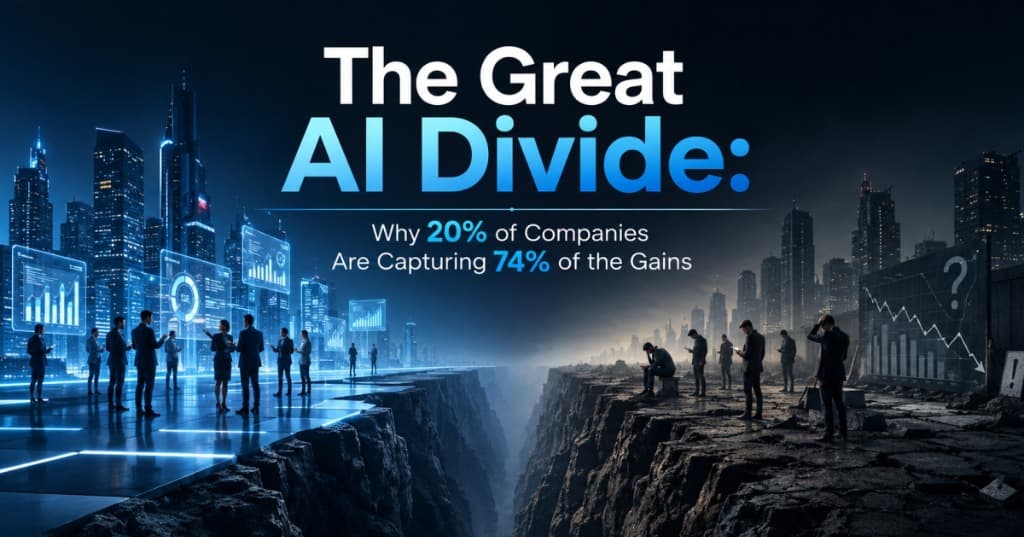
The Great AI Divide: Why 20% of Companies Are Capturing 74% of the Gains
Key Takeaways
- A massive performance gap has emerged, with 20% of companies capturing 74% of AI's economic value.
- AI leaders use the technology to identify growth opportunities and reinvent business models rather than just cut costs.
- Only 34% of organizations are actively reimagining processes, while 37% deploy AI at a surface level with no process change.
- CEOs who dedicate at least 8 hours a week to building AI capability are far more successful in generating ROI.
The most important number in business right now is not a stock price, a revenue figure, or a headcount. It is 20 percent. According to PwC's 2026 AI Performance Study — which surveyed 1,217 senior executives across 25 sectors — nearly three-quarters of AI's economic value is captured by just one-fifth of organisations, revealing a stark and widening divide between a small group of AI leaders and the majority of businesses still stuck in pilot mode.
That gap is not closing. It is widening — and the reasons are structural, not circumstantial.
The top-performing companies are not simply deploying more AI tools. Instead, they are using AI as a catalyst for growth and business reinvention, particularly by pursuing new revenue opportunities created as industries converge. These organisations are 2.6 times as likely as peers to report that AI improves their ability to reinvent their business model, and two to three times as likely as others to say they use AI to identify and pursue growth opportunities arising from industry convergence.
The data from Deloitte adds further texture. Worker access to AI rose by 50% in 2025, and the number of companies with 40% or more of their AI projects in production is set to double in six months. Yet only 34% of organisations are truly reimagining their businesses — using AI to create new products and services or reinvent core processes — while 37% are using AI at a surface level with little or no change to existing processes.
BCG's findings point to where leadership personally matters. CEOs who spend at least eight hours a week building their AI capabilities are more likely to generate meaningful value from the technology. Nearly three-quarters of CEOs are now their company's chief AI decision-maker, four out of five are more optimistic about ROI than a year ago, and more than 90% plan to continue investing at current or higher levels even if investments do not pay off in the next year.