How Nubank Built the World's Largest Digital Bank by Treating Every Customer as a Person, Not a Data Point
Key Takeaways
- Nubank scaled to 105 million customers across Latin America by focusing on human-centric, fee-free banking products.
- The digital bank bypassed technical debt by utilizing a cloud-native, microservices-based infrastructure.
- Serving previously underserved populations generated high customer loyalty, low churn, and strong lifetime value.
- Nubank integrated advanced AI across customer support and credit modeling while maintaining human guardrails.
From a São Paulo startup with no branches and no legacy to a $62 billion institution serving 105 million customers — Nubank's story is the most important case study in the history of financial inclusion. And it is not over yet.
Background: The Market Nobody Wanted
To understand what Nubank has built, you first have to understand what it entered. Brazil in 2013 was one of the most financially exclusionary markets on the planet — not because it lacked a banking system, but because its banking system had decided, for all practical purposes, that a significant proportion of the population was not worth serving.
The five largest banks controlled approximately 80% of the market. Annual fees on basic credit cards ran to the equivalent of hundreds of dollars. Interest rates on credit card balances were among the highest in the world — routinely exceeding 300% per annum. Customer service was, by virtually any measure, poor. And the physical infrastructure required to access financial services — the branches, the paperwork, the proof of address requirements, the credit history demands — systematically excluded tens of millions of Brazilians who earned less, moved more frequently, or simply did not fit the demographic profile that the incumbent banks had built their products for.
The founding insight behind Nubank was not primarily technological. It was ethical. David Vélez, Cristina Junqueira, and Edward Wible did not look at the Brazilian banking market and see a technology opportunity. They saw a moral failure — the deliberate exclusion of tens of millions of people from the basic financial infrastructure of a modern economy — and decided to address it by building a bank that those people might actually want to use.
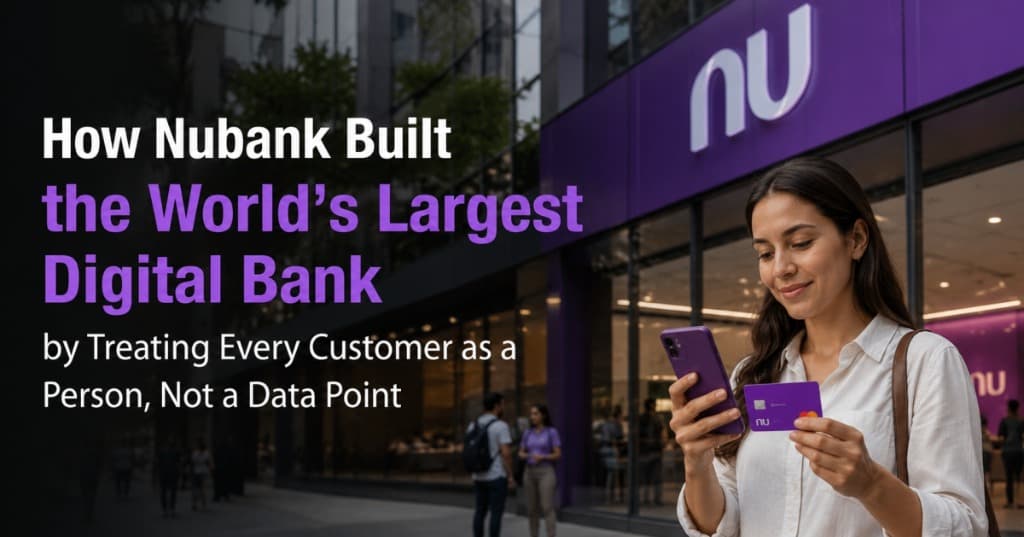
The product they started with was disarmingly simple: a no-fee credit card, managed entirely through a mobile app, with a customer service experience that was radically better than anything the incumbents offered. No annual fees. No hidden charges. A purple card that arrived in a distinctive box, as if someone had actually thought about the experience of receiving it. And a customer service model built around the idea that the person on the other end of the message was a human being deserving of a genuine response, not a case number to be resolved and closed.
The Growth Machine: How a No-Fee Card Became a Financial Ecosystem
The early growth of Nubank was driven by a combination of product quality and word of mouth that the incumbents were structurally incapable of replicating. When your product is genuinely better than the alternative — when it saves people money, treats them with respect, and works reliably on a device they already carry — those people tell each other. And in a market where the alternative was a system that had spent decades demonstrating its indifference to the people it was supposed to serve, the bar for "genuinely better" was not high.
The waitlist for Nubank's card became, in itself, a marketing phenomenon. Millions of Brazilians signed up for the right to be considered for a no-fee credit card. The waitlist created scarcity and desirability around a product that was, at its core, just a credit card — but a credit card offered by an institution that appeared to actually want them as customers.
The fintech sector's fastest growth in Latin America has been driven by a rapid expansion in lending, which has grown at about 50 percent annually since 2021. Nubank was both a beneficiary and a driver of that trend. As it expanded from credit cards into personal loans, savings accounts, insurance, investment products, and business banking, each new product entered a customer base that was already engaged, already trusted, and already accustomed to an experience that was fundamentally different from what the incumbents offered.
The geographic expansion followed a similar logic. After establishing dominance in Brazil — where it now serves more than 90 million customers — Nubank moved into Mexico and Colombia, applying the same founding insight: that there were tens of millions of people in each market who were underserved by their existing banking systems and would respond enthusiastically to a product that treated them as valuable customers rather than marginal credit risks.
By mid-2026, Nubank serves more than 105 million customers across Brazil, Mexico, and Colombia. It has grown at approximately 23 percent annually over the past four years — a rate that would be remarkable in any industry, and is extraordinary in financial services, where customer inertia is historically one of the most durable competitive moats.
The Economics of Inclusion: Why Serving the Underserved Is Good Business
One of the most persistent myths in financial services is that serving lower-income or previously excluded customers is a charitable activity that compromises commercial returns. Nubank's numbers make a compelling argument to the contrary.
The customers that Brazilian incumbent banks had decided were not worth serving turned out, when treated fairly and served well, to be remarkably valuable. Not because they had more money than the banks assumed — many did not — but because they were loyal in ways that customers who had other options were not. When you are the first institution to treat someone as a valued customer, the relationship that follows is not merely transactional. It is genuinely personal. Churn is lower. Cross-sell rates are higher. Lifetime value is significantly greater than the initial credit profile would suggest.
Nubank's unit economics reflect this. Customer acquisition costs are a fraction of the incumbents', because the word-of-mouth flywheel that a genuinely trusted product generates is far more efficient than any paid acquisition programme. Default rates, while higher than the prime customers that traditional banks prioritised, are managed through a proprietary credit model that uses thousands of alternative data points to assess creditworthiness in ways that conventional credit scoring cannot. The result is a loan book that performs better than the headline risk profile would suggest, because Nubank's model is better at identifying which customers — regardless of their formal credit history — will repay.
The profitability shift in fintech is stark: 69% of fintech companies going public today are profitable, up from 52% in the earlier cohort. Nubank's own path to profitability — which it achieved in 2023 and has sustained since — required discipline in unit economics that the startup mythology of the early fintech era rarely demanded. It required building a cost structure around digital-only operations that was genuinely lower than the incumbent model, not just aspirationally so. And it required resisting the temptation to grow into markets or product categories before the financial foundations were solid enough to support the expansion.
The Technology Architecture: Building for Scale Without Complexity
Nubank's technology architecture is, in the fintech industry, almost as influential as its product philosophy. The company made a deliberate decision in its early years to build on a cloud-native, microservices-based infrastructure rather than adopting legacy banking technology systems. That decision, which seemed unnecessarily complex at the time, became a fundamental competitive advantage as the company scaled.
The ability to launch new products quickly, to run experiments across different customer segments simultaneously, to update the core platform without the kind of scheduled downtime that characterises legacy banking systems — all of these capabilities flow from the architectural choices made when Nubank had fewer than a million customers. By the time it had 50 million, those choices were generating compounding returns in operational efficiency, product velocity, and customer experience quality that the incumbents, constrained by decades of accumulated technical debt, could not match.
In 2026, 80% of fintech companies already implement AI across multiple business areas including customer service, fraud detection, and process automation. Nubank has been building AI into its operations since well before this became industry standard. Its credit model, its fraud detection systems, its customer service routing, and its personalisation engine are all AI-driven — not as bolt-on features, but as foundational capabilities that the product was designed around.
The AI integration that has attracted the most recent attention is Nubank's approach to customer service at scale. Managing 105 million customer relationships with the kind of responsiveness and personalisation that built the brand requires a combination of AI capability and human judgment that most financial institutions have not yet achieved. Nubank's model — where AI handles the vast majority of routine interactions but human agents retain authority over any situation where the customer experience is at risk — has allowed it to maintain the customer service quality that was its original differentiator at a scale that human-only models could never support economically.
The Regulatory Journey: From Disruption to Institution
Nubank's relationship with financial regulation has evolved substantially from its early years, when Brazilian banking regulators viewed it with a mixture of suspicion and curiosity, to the present, where it is one of the most closely watched examples of how a digital-native financial institution can achieve regulatory maturity without sacrificing innovation velocity.
The Brazilian central bank's decision to grant Nubank a full banking licence in 2019 was a watershed moment — not just for Nubank, but for the entire Brazilian fintech ecosystem. It demonstrated that the regulatory framework could accommodate a digital-only institution, and it gave Nubank the ability to offer the full range of banking services that a licence permits.
Regulators in 2026 expect fintechs to build for supervision from the start, with pre-licensing inquiries, partnership reviews, and scrutiny of embedded finance models becoming standard. Nubank's experience in Brazil — where it built a compliance infrastructure that exceeded regulatory requirements, developed strong relationships with the central bank, and demonstrated that financial inclusion and regulatory compliance were complementary rather than competing objectives — became the template for its expansion into Mexico and Colombia.
In Mexico, where the regulatory environment for digital banking was less developed when Nubank entered, the company worked actively with regulators to help shape the frameworks that would govern digital financial services. That engagement was not altruistic. It was strategic. A company that helps write the rules has a structural advantage over companies that arrive after the rules are written.
The model of converting international ambition into deeper, market-level authorisations — rather than operating at the margins of existing regulatory frameworks — is increasingly the playbook of the most successful global fintechs. Nubank pioneered this approach in Latin America. Revolut is executing a version of it in the UAE and across Europe. The pattern is consistent: build regulatory credibility in your home market, use it as a foundation for international expansion, and treat each new market's regulatory relationship as a strategic investment rather than an operational overhead.
The Culture Question: Building a Culture That Scales Without Losing Itself
One of the most underappreciated challenges in Nubank's growth story is the cultural one. The company that began with a small team in São Paulo, united by the conviction that financial services could and should be built differently, now employs thousands of people across three countries and must somehow maintain the values and the judgment that made the original product exceptional at a scale where culture becomes genuinely difficult to manage.
Nubank has approached this challenge with a level of intentionality that is relatively rare in high-growth technology companies. Its internal culture document — which it publishes externally — is not a list of aspirational values but a specific articulation of how decisions should be made, how trade-offs should be resolved, and what it means, in practice, to behave consistently with the founding commitment to the customer.
The most important element of that commitment, in the context of scale, is the refusal to treat growth as a justification for compromising customer experience. When Nubank's systems experience downtime — as all systems do, at scale — the response is not a canned corporate apology. It is a personal acknowledgment, addressed to the specific customer who was affected, of what happened and what has been done to prevent it. That level of accountability at scale is expensive. It requires investment in customer service infrastructure that most organisations at Nubank's stage of growth would redirect toward product development.
Nubank invests in it anyway, because the founding insight — that the customer relationship is the product, not the financial instrument that relationship enables — has not changed as the company has grown. The purple card was always a mechanism for initiating a relationship. Everything else Nubank has built since is a way of deepening it.
What the Nubank Story Means for Every Financial Services Organisation
The Nubank case study is, on one level, the story of a specific company in specific markets at a specific moment in the history of financial technology. On another level, it is a demonstration of a principle that applies to every organisation in every market at every stage of development.
The principle is this: the customers that incumbents decide are not worth serving are almost always worth serving — just not on the incumbents' terms. And the company willing to redesign its terms around the customer, rather than around the conventions of its industry, will find a market that is simultaneously larger than the incumbents believed and more loyal than the demographics suggested.
Fintech's share of global financial services revenue is expected to rise from 2% to 7% by 2030, with much of that growth coming from emerging markets. Nubank is both a cause and an early beneficiary of that shift. The growth it has achieved in Brazil, Mexico, and Colombia represents not the ceiling of what is possible but the floor — the proof of concept that will now attract the capital, the talent, and the competitive pressure that will accelerate financial inclusion across every underserved market in the world.
The lesson for incumbent financial institutions is not that they should become Nubank. It is that they should ask, with genuine honesty, which customers they have decided are not worth serving — and whether the real answer to that question is "not worth serving on our current cost structure and with our current mindset," rather than "not worth serving at all."
The lesson for new entrants is that the path from disruption to institution requires exactly the investment in compliance, governance, and cultural integrity that is least visible from the outside and most consequential over time.
And the lesson for investors is perhaps the simplest: in financial services, as in most relationship-intensive businesses, trust is the asset class with the best long-term risk-adjusted returns.
Nubank built that asset class from scratch, in a market where the incumbents had spent decades depleting it. What it has achieved as a result is not just a business. It is a proof of concept for a better version of financial services — one that the rest of the world is now, slowly and imperfectly, trying to replicate.
*Sources: McKinsey Global Fintech Report 2026, BCG/FT Partners Global FinTech Report 2026, CB Insights State of Fintech Q1 2026, N-iX Fintech Trends 2026, Bloomberg, CNBC, WhiteSight Radar, DL News, FinTech Futures, Banking Dive.*