The Electricity Century: Why Control of Clean Power Is the Defining Geopolitical Contest of Our Time
Key Takeaways
- Energy security has merged with national security, making reliable and abundant clean power the defining catalyst for economic growth.
- Hyperscale AI infrastructure demands massive 24/7 firm, low-carbon power, triggering a global competition for clean energy assets.
- Nuclear energy is undergoing a historic resurgence led by SMR investments, high-capacity corporate PPAs, and decisive policy backing.
- Sodium-ion battery technology at ~$19/kWh offers a cost-effective solution to renewable intermittency, disrupting gas peaker economics.
There is a sentence that appears, in different forms, in almost every major energy report published in 2026. It says, in effect, that energy security is now national security. That electricity is the new oil. That whoever controls reliable, abundant, clean power in the next decade controls economic growth.
These sentences have become so familiar that they risk becoming clichés — absorbed into the background noise of policy discussion rather than registered as the genuinely extraordinary claim they represent. So it is worth pausing to ask what it actually means, concretely and specifically, for the world's governments, corporations, and investors — and why the answer to that question is reshaping geopolitics, industrial strategy, and capital allocation at a speed that most institutions have not yet processed.
What Changed and When
For most of the twentieth century, the geopolitical currency of energy was oil. The nations that controlled oil supplies — or the infrastructure through which it was transported — exercised a form of strategic leverage that translated directly into political power. The crises that shaped the modern world — the 1973 Arab oil embargo, the Iranian Revolution, the Gulf Wars, the 2022 Russian invasion of Ukraine — were all, at their core, energy security crises. Control oil, control the global economy.
The Iran conflict of early 2026 — and the brief Hormuz closure that followed — was the last major demonstration of that old paradigm. For three weeks in February, approximately 20% of the world's oil supply was inaccessible. Fuel shortages rippled through Asia. Shipping costs spiked. Economies that believed they had diversified their energy mix discovered how much they still depended on a single geographic chokepoint.
But even as the Hormuz crisis played out, the deeper energy story of 2026 was not oil at all. It was electricity — and specifically, the race to secure the clean, reliable, abundant electricity that the AI economy requires at a scale the existing grid was never designed to provide.
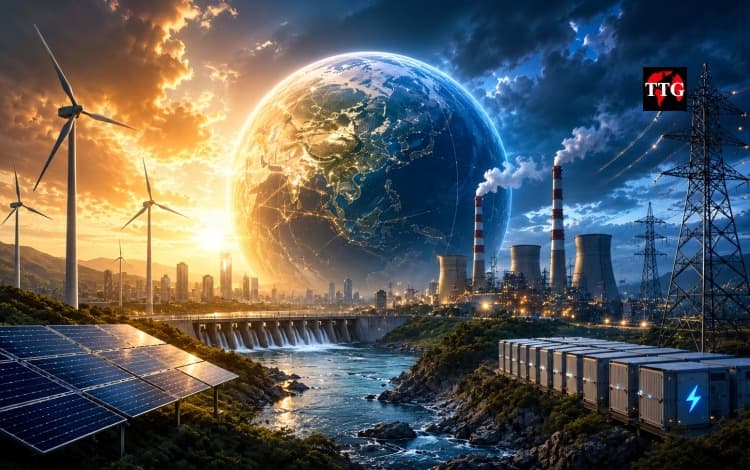
The EIA's July 2026 Short-Term Energy Outlook shows renewable generation growth, particularly from solar, supplying much of the year-over-year increase in generation — alongside natural gas, wind, and nuclear. What is striking about that mix is not any single component but the sheer breadth of the portfolio that the energy transition now requires. This is not a story about solar replacing coal. It is a story about every available generation technology being deployed simultaneously at unprecedented scale — because the demand growth is that large and the urgency is that acute.
The AI Factor: Demand That Was Not in the Model
Hyperscalers are driving unprecedented demand for firm, low-carbon power, and the United States hosts 90% of hyperscalers' global carbon-free energy contracts. That concentration — 90% of the world's hyperscale clean energy contracting in a single country — reflects the current geography of AI infrastructure. But it also reflects a vulnerability. As AI infrastructure builds out globally, the competition for clean power will become an international contest, not a domestic procurement exercise.
The EU's Tech Sovereignty Package, announced in June 2026, includes plans to triple EU data centre capacity over the next five to seven years. The European Commission has unveiled a strategy to bring Europe's first SMRs online by the early 2030s, with PINC estimating that around €241 billion in investments will be needed by 2050 to deliver on EU countries' nuclear ambitions. Germany and Japan are both significantly increasing energy investments. The Middle East has deployed hundreds of billions in sovereign capital toward energy diversification, recognising that an economy built on oil revenues cannot thrive in a world where electricity is displacing petroleum across transportation, industry, and now computing.
This is the geopolitical contest of the next decade, and it is already underway. Not a military contest, though energy security and military capability are increasingly intertwined. Not a trade contest in the conventional sense, though access to energy-intensive supply chains depends on it. It is an infrastructure contest — a race to build the physical foundation of the AI economy before the competitors do, and to build it on clean power that does not create the import dependency and chokepoint vulnerability that oil did.
The Nuclear Moment: From Reluctance to Conviction
No energy technology has undergone a more dramatic rehabilitation in the public and policy imagination over the past three years than nuclear. And the driver of that rehabilitation is not, primarily, climate concern — though nuclear's zero-carbon credentials matter. It is the recognition that reliable baseload power — power that is available 24 hours a day, 365 days a year, regardless of weather conditions — is a prerequisite for the AI infrastructure that hyperscalers are building, and that nuclear is the only proven technology that can deliver it at scale.
Microsoft signed a approximately $16 billion, 20-year power purchase agreement for the entire 835 MW output of the Three Mile Island Unit 1 restart, now renamed the Crane Clean Energy Center. Meta announced deals for up to 6.6 GW of nuclear capacity. Google signed the first US corporate SMR fleet deal with Kairos Power for 500 MW. These commitments, made by three of the most financially sophisticated organisations in the world, represent a verdict on nuclear's role in the clean energy future that is far more meaningful than any policy statement or academic study.
Small modular reactors target capital expenditure of $4,000 to $7,000 per kilowatt on a Nth-of-a-kind basis, versus $8,000 to $12,000 per kilowatt for recent large reactor builds, with construction timelines compressed from six to ten years to three to five years. Those economics — if the factory manufacturing model delivers on its promise — would make nuclear genuinely cost-competitive with gas peakers and significantly cheaper than the integrated storage systems required to firm intermittent renewables for 24/7 data centre operations.
In the United States, the Trump administration unveiled a 400 GW-by-2050 nuclear target, with the DOE awarding $800 million to TVA and Holtec for Clinch River SMR-300 deployment and launching a $2.7 billion HALEU procurement. The policy backing, the private capital, and the corporate offtake commitments are now aligned in a way they have not been since the original nuclear buildout of the 1960s and 1970s.
The Battery Wild Card
Against this backdrop of nuclear momentum, the battery technology story of the past twelve months deserves far more attention than it has received. CATL has invested around CNY 10 billion in sodium-ion battery research and development since 2016. Nature says sodium-ion batteries, which will soon enter mass production, could change the world. They could ultimately be a cheaper, safer alternative to lithium in electric cars and other energy applications. Sodium-ion technology has overcome key challenges related to mass production and is ready for large-scale deliveries.
CATL's new sodium-ion battery cell costs roughly $19 per kilowatt-hour at the cell level, compared to standard lithium iron phosphate cells at $55 to $60. With just solar panels and batteries, the economic case for burning fossil fuels at night disappears.
If sodium-ion batteries deliver on their commercial promise — and the early production data from CATL suggests they will — they fundamentally change the economics of renewable energy. The persistent critique of solar and wind has always been intermittency: the sun does not always shine, the wind does not always blow, and storing the surplus for when it does not has historically been too expensive to make renewable-plus-storage competitive with dispatchable power. A battery that costs a third of what lithium costs changes that calculation decisively.
The fact that batteries can ramp up their delivery very quickly means they can take over the job currently done by peaker gas turbines that kick on when there is sudden high demand for short periods of time. Peaker gas plants are both the most expensive and the most carbon-intensive part of most electricity grids. Replacing them with battery storage at $19 per kilowatt-hour is not just an environmental win. It is an economic one — and it is the kind of economic win that accelerates adoption faster than any policy mandate could.
What Governments Must Do That Most Are Not
The energy transition at this scale and speed requires a form of state capacity that most democratic governments have not demonstrated since the post-war infrastructure buildouts of the 1940s and 1950s. It requires planning horizons that extend beyond electoral cycles. It requires the ability to make large, irreversible commitments to infrastructure projects that will not deliver their value for a decade. And it requires the willingness to make trade-offs — between speed and community consultation, between domestic manufacturing and import efficiency, between the interests of incumbent energy operators and the requirements of the clean energy future.
In 2026, developers are working toward front-loading construction to secure safe-harbour eligibility, diversifying suppliers and investing domestically to manage FEOC restrictions and tariffs, and siting projects where market drivers, RPS support, and permitting clarity sustain deployment. Supply chain and workforce challenges persist, underscoring the new playbook: build fast, stay flexible, and invest in resilience.
That playbook — build fast, stay flexible, invest in resilience — is the operating philosophy of the energy transition in 2026. It is not a comfortable philosophy for institutions built around deliberation, consensus, and the management of risk rather than the acceptance of it. But it is the philosophy that the scale and urgency of the energy challenge demands.
The electricity century has begun. The contest for its commanding heights is already underway. And the organisations and nations that understand this earliest — and act on that understanding most decisively — will define the terms on which everyone else must compete for the next fifty years.
Frequently Asked Questions
Why is electricity becoming the defining geopolitical asset?
Electricity drives AI computing, modern industrial processes, and digital infrastructure. Control of clean, reliable 24/7 baseload power determines national competitiveness, energy security, and economic independence.
How are hyperscalers impacting clean power demand?
Tech giants building AI data centers require unprecedented amounts of firm, zero-carbon electricity, driving major power purchase agreements in nuclear, SMRs, and renewables.
What role do sodium-ion batteries play in the energy transition?
With cell costs as low as $19/kWh, sodium-ion batteries provide a cheaper, safer alternative to lithium for grid storage, solving renewable intermittency and eliminating reliance on gas peaker plants.