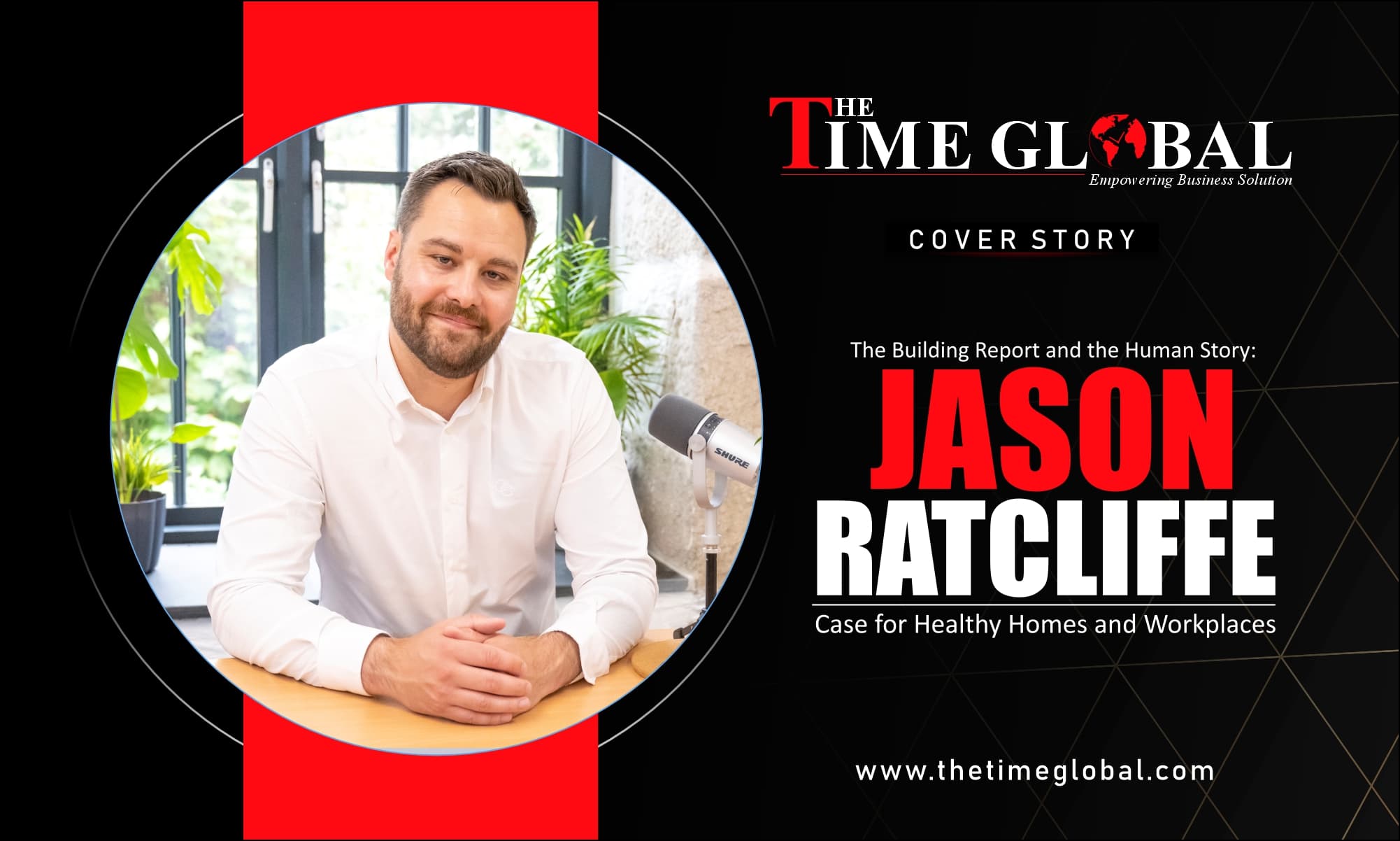
The Building Report and the Human Story: Jason Ratcliffe's Case for Healthy Homes and Workplaces
Key Takeaways
- The Wellbeing Surveyor connects technical building pathology with public health and human wellbeing to protect lives and livelihoods.
- Wellbeing surveys examine buildings as occupied environmental systems—evaluating indoor air quality, thermal dynamics, moisture, and lived experience.
- Jason Ratcliffe invented the Elemental Cube™ to deliver safe, repeatable, and in-situ thermal measurements in occupied properties.
- Indoor spaces are exposure pathways; damp and mould require systemic defect diagnosis and ventilation correction rather than blaming occupant lifestyle.
- Workplaces and homes require post-occupancy evidence and proactive facilities management, treating healthy indoor air as essential infrastructure.
The Building Report and the Human Story: Jason Ratcliffe's Case for Healthy Homes and Workplaces
The Moment the Question Changed
In his own words:
"It was less a single dramatic moment than a pattern I could no longer ignore. I would inspect a property, identify the technical defects, and then listen to the occupant describe what those conditions meant in real life: a child sleeping beside mold, a family unable to heat every room, someone avoiding a space because it affected their breathing or overwhelmed their senses. The building report and the human story were describing the same problem in different languages."
"That changed the question I asked. Instead of looking only at what was wrong with the building, I began asking what the building was doing to the person. Cornwall sharpened that thinking. Its historic homes, exposed climate, moisture pressures, and energy challenges show why standard assumptions are often inadequate. My own experience of neurodivergence and ill health also made me conscious that people experience heat, light, sound, and air differently."
"The Wellbeing Surveyor grew from that convergence. It is not a rejection of traditional surveying; it expands its purpose. Sound building pathology remains essential, but the ultimate reason we diagnose defects is to protect people, livelihoods, and the meaning of home."
What a Wellbeing Survey Actually Is
"A conventional survey typically explains the construction, condition, defects, and risks of a property. A well-being survey retains that technical discipline but examines the building as an occupied environmental system. We consider temperature, moisture, ventilation, indoor air quality, thermal comfort, materials, light, noise, and how the rooms are actually used. Most importantly, we listen to the people inside."
"The purpose is to connect evidence. A patch of mold may relate to a cold surface, inadequate extraction, intermittent heating, external water entry, or several factors acting together... Measurements are valuable, but they must be interpreted alongside the fabric, services, weather, and lived experience."
He's explicit about what the deliverable actually is:
"The outcome is not a vague wellness score. It is a prioritized explanation of risk and practical action: what needs attention, why it matters, what further investigation is justified, and how improvements can be made without creating unintended consequences."
Connected by Exposure
"They are connected by exposure. Surveying explains the physical environment; public health examines how environmental conditions influence populations; workplace well-being considers how those conditions affect people's ability to function, feel safe, and perform. The boundaries are professional, not biological. A person does not stop breathing indoor air because responsibility has passed from a facilities team to a landlord."
On where his own authority stops:
"My fellowship in the Royal Society for Public Health, surveying practice and doctoral research, allows me to translate between these worlds. I do not claim that a building inspection diagnoses illness; that belongs to healthcare professionals. My role is to identify environmental evidence, communicate uncertainty responsibly, and help remove or reduce plausible building-related risks."
Building the Elemental Cube™
"The Elemental Cube began with a research problem: how do we obtain meaningful in-situ thermal measurements when external weather refuses to cooperate? Heat-flow testing is sensitive to temperature difference and changing conditions... I wanted a portable, single-unit chamber that could create a controlled local environment against a wall while the building remained in use."
Developing it required me to move between researcher, surveyor, and inventor. The concept had to become something safe, transportable, repeatable, and credible under site conditions... Recognition as a Green Hero at Grand Designs Live and at the SEED research conference was valuable because it showed that rigorous building-performance work could also capture public imagination."
"The greatest lesson was that innovation is rarely a flash of inspiration followed by a finished product. It is disciplined persistence: define the measurement problem, test what fails, document it, and improve the system until others can trust the evidence it produces."
What the Research Actually Shows
"Temperature is never only a comfort setting. It interacts with surface temperature, humidity, air movement, moisture, and the amount of energy a household can afford. A room may show an acceptable air temperature while cold surrounding surfaces still make an occupant feel uncomfortable and increase condensation risk."
On the state of the industry, he's careful not to overstate the case:
"I would not describe the sector through a single measure of being 'behind.' There is substantial expertise and progress. The priority is to strengthen the connection between design intent, installation quality, and post-occupancy evidence, particularly in older buildings where moisture-safe, context-specific solutions are essential."
More Than an Inconvenience
"I wish people understood that the indoor environment is an exposure pathway, not merely a matter of appearance. Mold is not just an unsightly mark to paint over... The emotional impact is also underestimated. Living with persistent damp, odor, or cold can create shame, anxiety, disrupted sleep, and conflict. Tenants may fear they will be blamed; parents may worry about their children; vulnerable people may retreat into one heated room."
"The language used by professionals matters because 'lifestyle' can become a careless way of transferring responsibility to the occupant."
His prescription, when a genuine pattern emerges:
"Clean the immediate contamination safely, identify the moisture source, assess ventilation and heating, and correct the underlying building or service failure rather than treating the visible surface alone."
A Stage and a Role Closer to Home
On why he built TEDxTruro:
"TEDx appealed to me because a well-told idea can cross professional boundaries. Research can be technically robust and still fail to change anything if it remains inaccessible... Organizing it taught me that leadership is not always about being the person speaking. It is about building the conditions in which other people can be heard."
On being a LionHeart Ambassador, a role he describes as personal rather than ceremonial:
"The role is personal because I am neurodivergent. I understand the effort involved in navigating a profession whose systems, communication styles, and sensory environments may not have been designed with different minds in view... Being an ambassador means helping people recognize that asking for support is a strength, not a professional failure."
"Inclusion is not about lowering standards. It is about removing unnecessary barriers so that competence can be seen and people can build sustainable careers without concealing who they are."
Replacing Shame with Agency
On why he started the Heal Your Home podcast:
"I started Heal Your Home because a technical report reaches one client, while a clear conversation can help thousands of people ask better questions. Homeowners and tenants are surrounded by contradictory advice: open windows, turn up the heat, buy a dehumidifier, and replace the insulation. Some advice may help in a particular situation, but no single instruction explains the building as a system."
"The conversations that stay with me are those in which someone realizes the problem is neither imaginary nor a personal failure. When people understand the relationship between cold surfaces, moisture, ventilation, affordability, and construction, shame can be replaced by agency."
The Workplace Nobody's Measuring
"The most common issue is that workplaces are assessed as averages while people experience them individually. One temperature setpoint, one lighting strategy, or one ventilation schedule will not suit every task, body, or neurotype... Maintenance and operational drift are frequently overlooked. Ventilation may have been designed correctly, but filters, controls, sensors, or schedules no longer perform as intended."
"The answer is not a collection of wellness perks. It is good facilities management supported by occupant feedback and appropriate measurement... A fruit bowl cannot compensate for air that makes people tired or a workspace they cannot tolerate."
Earning the Authority
On visibility, and what he thinks it's actually for:
"Visibility is useful only if it carries substance. Awards, features, conferences, and podcasts can open doors, but credibility is earned by being accurate, acknowledging limits, and returning attention to the people affected. I do not want to be visible merely to promote a personal brand. I want healthy buildings to become a mainstream public conversation."
On why the industry still treats well-being as a marketing line rather than a genuine priority:
"The challenge is less a single source of resistance than a system of fragmented responsibilities. Design, construction, handover, occupation, maintenance, and healthcare often operate separately. Costs are visible immediately, while the benefits of prevention may appear later and in another organization's budget. Compliance can therefore become the finish line even when it was intended as a baseline."
"Structural safety and energy efficiency gained authority through evidence, standards, accountability, and cultural change. Indoor health needs the same seriousness, but it should be integrated rather than treated as a competing priority."
Holding It Together
"No two days are identical. I may begin with a building inspection, review environmental monitoring data, write part of my PhD, speak with a client, develop a research instrument, or prepare public education content. There are also the less visible parts of entrepreneurship: finance, compliance, team decisions, setbacks, and protecting enough time to think."
He's honest that the mission doesn't guarantee balance:
"I also have to be honest that holding it together does not mean perfect balance. I am a husband, father, researcher, business owner, and someone managing my own health. Sustainable leadership sometimes means slowing down, delegating, and refusing opportunities. Credibility is not built by pretending to be limitless; it is built by remaining responsible to the work and the people who depend on you."
Start With a Pattern, Not a Product
His advice to anyone wondering if their own space is making them unwell:
"The first question is: when, where, and under what conditions do I notice the problem? Look for patterns rather than starting with a product. Does discomfort occur in one room, after cooking, overnight, during wet weather, when the office is crowded, or when heating has been off? Do several occupants experience it? Has anything changed in the building, its use, or its maintenance?"
"Avoid assuming that a single monitor, dehumidifier, or cleaning treatment proves the cause. Data becomes meaningful through context. A structured timeline helps a surveyor, facilities manager, or healthcare professional understand the pattern and decide what evidence or action is needed next."
The Doubt That Sharpened the Mission
"Creating language for work that sits between established disciplines can be isolating. People understand a building survey, and they understand well-being, but combining the two can initially sound abstract. There were times when I wondered whether the profession or public would see it as credible, particularly while I was also navigating research, business pressures, neurodivergence, and serious health challenges."
What kept him going wasn't recognition. It was the moments of clarity his clients found:
"The doubt has been useful because it forces me to keep earning the title. The wellbeing surveyor cannot rest on a compelling name. It must be supported by competent surveying, transparent methods, research, collaboration, and an ethical refusal to claim more than the evidence allows."
What Success Actually Looks Like
"My wider ambition is to help the property and health sectors treat the home and workplace as important determinants of well-being. I want surveyors, designers, housing providers, employers, researchers, and public-health professionals to share evidence earlier, rather than meeting only after a problem has escalated."
"The change is cultural as much as technical: from blaming occupants to investigating systems; from relying only on design intent to verifying outcomes; and from considering wellbeing a premium feature to recognizing healthy indoor environments as essential infrastructure."
"Years from now, I hope the measure of success will be simple: fewer people made unwell or powerless by the places intended to shelter and support them."
Frequently Asked Questions
Who is Jason Ratcliffe and what is 'The Wellbeing Surveyor'?
Jason Ratcliffe is a building surveyor, doctoral researcher, and Fellow of the Royal Society for Public Health known as 'The Wellbeing Surveyor'. His work connects building pathology, environmental data, and public health to advocate for healthier homes and workplaces.
What is a wellbeing survey compared to a conventional building survey?
A conventional survey inspects construction, defects, and structural risks. A wellbeing survey retains that technical discipline while examining the property as an occupied environmental system—assessing temperature, moisture, indoor air quality, light, acoustic comfort, and occupant health.
What is the Elemental Cube™?
The Elemental Cube™ is an innovative portable testing chamber invented by Jason Ratcliffe that creates a controlled local environment against a wall, enabling reliable in-situ thermal and heat-flow measurements without depending on external weather.