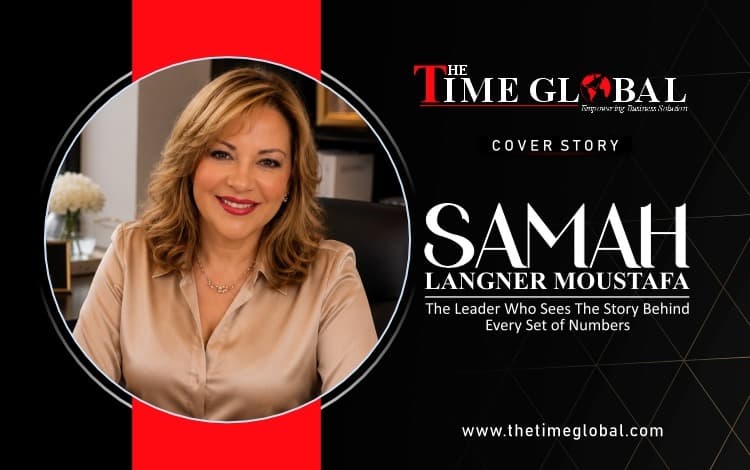
Samah Langner Moustafa: The Leader Who Sees The Story Behind Every Set of Numbers
Key Takeaways
- Strategic Agility: Adapting quickly while maintaining focus on long-term goals—particularly when conditions change unexpectedly.
- Human-Centered Finance: Recognizing that every financial decision affects real people and leading with that awareness at every level.
- Data-Driven Leadership: Using analytics and real-time insights to turn data into decisive, well-informed action.
- Cross-Border Operational Excellence: Building financial systems and processes that grow efficiently across multiple entities in the US and Germany.
There is a moment in every organization's life when the numbers on a spreadsheet stop being figures and begin telling a story of where a company has been, where it is struggling, and, if someone is paying close enough attention, where it could go. Samah Langner Moustafa has spent her career being that person: the one who listens to what the numbers are saying and then builds the bridge between financial reality and strategic possibility.
As Group CFO of Go Behavioral LLC—a behavioral health organization operating across multiple entities and locations in the United States and Germany—she has done precisely that. Under her financial leadership, Go Behavioral has navigated significant growth, strengthened its operational infrastructure, and built the kind of cross-border financial discipline that allows a mission-driven organization to scale without losing its integrity. Her journey to that position was neither linear nor easy. It was forged across continents, shaped by the pressures of organizational growth, and refined through the kind of leadership that only comes from navigating complexity without a safety net.
A Curiosity That Would Not Stay Still
Samah Langner Moustafa’s entry into finance was not driven by a love of spreadsheets or a desire to audit balance sheets. It was driven by a simpler and more enduring impulse: curiosity. Specifically, curiosity about how organizations grow, how they sustain themselves through turbulence, and how they create value that outlasts any single leader or market cycle.
After completing her accounting education and building a strong technical foundation, she moved through financial environments in Egypt and Germany before stepping into international operations. Each transition exposed her to different pressures, different cultural contexts for decision-making, and different expectations about what financial leadership was supposed to look like.
What she discovered, across all of those contexts, was a persistent gap. Finance was being treated as a reporting function rather than a strategic one. Leaders were looking backward when they needed to be looking forward. And the people most affected by financial decisions—the employees, the teams, the frontline operators—were rarely part of the conversation.
> *"The experiences that shaped me most were not the successes. They were the periods of rapid expansion, limited resources, and complex decision-making where financial leadership directly influenced organizational outcomes."*
It is an admission that speaks to the kind of leader she has become: someone who does not romanticize difficulty but recognizes that difficulty is, more often than not, where the most important lessons live.
---
When Finance Becomes Leadership
Ask Samah Langner Moustafa to describe her leadership philosophy, and she will not offer you a mission statement. She will give you an account of how her thinking has changed over time.
> *"My leadership philosophy has evolved from focusing solely on numbers to understanding that finance is ultimately about people, trust, and strategic decision-making."*
That evolution did not happen overnight, and it did not happen in a classroom. It happened in the room where the difficult conversations take place—where a CFO has to explain to a leadership team why a growth plan is financially unsound or where she has to justify a decision to invest in infrastructure that will not show returns for two years. In those moments, technical competence is the entry ticket. What actually moves the room is the ability to be transparent, to be consistent, and to make the ‘why’ behind a decision feel as important as the 'what.'
Samah Langner Moustafa believes, fundamentally, that financial leaders must be approachable. That word *approachable* might seem unremarkable. But in a discipline that has historically been characterized by gatekeeping and opacity, it represents a genuine shift in mindset. It means that the CFO is not the person who signs off on budgets from behind a closed door; she is the person who sits with department heads to understand what they actually need and then helps them build a financial case for it.
> *"Transparency, accountability, and consistency build stronger organizations than control alone."*
It is a principle that sounds simple but demands a kind of courage in practice. Control is comfortable. Transparency is not.
---
Leading Go Behavioral’s Growth Across Two Continents
The most concrete expression of Samah Langner Moustafa’s financial leadership is visible in what she has built and sustained at Go Behavioral LLC. As Group CFO, she oversees the financial operations of a multi-entity organization spanning multiple locations across the United States and Germany—an environment that demands not only technical precision but the kind of cross-jurisdictional governance expertise that is genuinely rare.
Managing multi-entity operations across two countries means navigating different regulatory frameworks, different reporting standards, different currency considerations, and different compliance obligations simultaneously and without margin for error. Under her leadership, Go Behavioral has developed the financial infrastructure to manage this complexity: unified reporting systems, standardized controls, and the kind of cross-functional alignment that allows the organization to make strategic decisions with clarity and confidence.
She has played a central role in driving the organization's growth strategy—not simply tracking it after the fact, but actively shaping it. From building financial models that inform expansion decisions to designing operational frameworks that can absorb increased scale without sacrificing efficiency, her contribution is woven into the fabric of how Go Behavioral functions as a growing enterprise.
> *"Finance cannot operate in isolation. The best financial outcomes emerge when every department is moving toward the same goals and when the CFO is helping to make that alignment possible."*
That collaboration is not incidental to her role. It is the role. She works closely with operations, human resources, clinical leadership, technology teams, and executive management—not because the organizational chart requires it, but because she understands that durable financial performance is always the product of organizational coherence.
---
Strategy First. Numbers, Second.
One of the persistent misunderstandings about the CFO role is that financial strategy and business strategy are parallel tracks—related, but ultimately separate. She rejects that framing entirely.
> *"Financial strategy must never operate independently from business strategy. I begin by understanding the organization's goals, then translate them into measurable financial frameworks."*
In practice, this means that whether an organization is considering expansion into a new market, investing in automation, or simply trying to improve operational efficiency, the financial architecture around that decision must be built to serve the ambition—not constrain it. Budgeting, forecasting, and performance monitoring are not administrative exercises; they are the instruments through which strategy becomes accountable.
This philosophy is particularly relevant at a moment when many organizations are managing the tension between short-term financial performance and long-term investment. Samah Langner Moustafa does not see that tension as irresolvable. She sees it as the defining challenge of modern financial leadership—one that requires a CFO who is as comfortable in a boardroom strategy session as she is in a detailed cash-flow review.
> *"Sustainable success comes from maintaining financial discipline while continuously preparing the organization for the future."*
---
Growth, Pressure, and the Art of Staying Calm
Every organization that grows quickly discovers, at the worst possible moment, that its internal processes were not designed for the company it has become. Reporting structures that worked at fifty employees begin to crack at two hundred. Financial controls that felt robust in one location start showing gaps when applied across five. Communication that was effortless when everyone shared an office becomes an operational challenge when teams are distributed across time zones and geographies.
Samah Langner Moustafa has led organizations through precisely this scenario, and it has left a permanent mark on how she thinks about financial leadership. At Go Behavioral, managing rapid growth across U.S. and German operations has required her to build systems that anticipate scale—not simply respond to it. That means investing in infrastructure before growth creates pressure on operations, not after. It means standardizing processes across entities before inconsistency becomes a compliance risk. And it means keeping the financial team aligned and prepared even when the pace of change is outrunning the organization's existing playbook.
> *"Strong leadership requires remaining calm under pressure and making decisions based on facts rather than emotions. When growth is rapid and uncertainty is high, the ability to stay anchored in data is not just a technical skill—it is a form of discipline."*
Where some leaders retreat into rigidity under pressure—imposing controls, adding layers of approval, slowing decisions down—she moves toward adaptability. She builds systems designed not for where the organization is, but for where it is heading.
---
The Modern CFO: Strategic Partner, Not Guardian
The title of CFO carries a great deal of historical baggage. For generations, the role was defined primarily by what it protected against: mismanagement, compliance failures, and overspending. The best CFO in that model was the one who kept the tightest books.
Samah Langner Moustafa inhabits a fundamentally different version of the role. In her view, the CFO’s primary function is not guardianship but partnership. And the difference is not semantic. A guardian says no. A partner asks how. A guardian protects the organization from risk. A partner helps the organization understand which risks are worth taking—and builds the foundation to take them intelligently.
> *"Today’s financial leaders drive innovation, digital transformation, risk management, and organizational strategy. CFOs are expected to provide insights that guide decisions, improve operational performance, and support sustainable growth."*
That philosophy is not abstract at Go Behavioral. It is visible in how she approaches every cross-functional relationship—working alongside operations, human resources, clinical leadership, technology, and executive management as a genuine strategic contributor, not a financial gatekeeper. The result is an organization where financial thinking is embedded in strategic decision-making at every level, not consulted after the fact.
---
On Technology, AI, and the Irreplaceable Human Element
Few conversations in the finance world generate as much noise—or as much genuine uncertainty—as the question of what artificial intelligence will do to the profession. Some predict the wholesale automation of analytical functions. Others argue that the human elements of financial leadership are irreplaceable. Samah Langner Moustafa’s position is, characteristically, more nuanced than either extreme.
> *"AI and automation are transforming finance by reducing manual work, improving accuracy, and providing real-time insights. But technology should make human judgment better—not replace it."*
She sees genuine strategic value in the technology—for forecasting, for risk analysis, for compliance monitoring, for operational optimization. These are areas where speed and precision matter enormously and where machine intelligence already outperforms manual processing in many respects. At Go Behavioral, integrating technology into financial operations has been a deliberate part of building the infrastructure needed to manage multi-entity complexity at scale.
But the line she draws is clear. When an organization is deciding whether to enter a new market, acquire a competitor, or restructure in the face of financial pressure, those decisions require context, judgment, and an understanding of how they will affect the people inside the business. No algorithm can supply that. Artificial intelligence can sharpen the data. Only an experienced leader can determine what that data means for the human beings it will ultimately affect.
> *"The organizations that will thrive are those that combine advanced technology with strong leadership and sound decision-making—not those that mistake one for the other."*
---
Building Teams That Actually Perform
Behind every high-performing finance function, there is usually a leader who has given their team something that many organizations talk about but few actually deliver: genuine accountability paired with genuine support.
For Samah Langner Moustafa, building a team is not an exercise in assembling the right credentials and hoping for the best. It is a deliberate, continuous practice grounded in a clear belief: that people do their best work when they understand what they are doing, why it matters, and that someone in a position of authority is invested in their development.
> *"Great teams are built on trust, clear expectations, continuous learning, and accountability. High-performing teams thrive when people feel respected, supported, and encouraged to grow professionally."*
Coaching and mentoring are not peripheral activities in her leadership model—they are central to it. She understands that the next generation of financial leaders is being shaped right now, inside organizations like Go Behavioral, by leaders who invest in people before those people have proven themselves. That investment, made consistently and without condition, is what turns a competent team into an exceptional one.
---
The Future: Challenges That Cannot Be Ignored
When Samah Langner Moustafa surveys the financial landscape of 2026 and beyond, she sees a profession undergoing structural transformation. The forces driving that transformation are not marginal: the proliferation of advanced analytics, increasing levels of automation, rising expectations for governance and transparency, the growing importance of cybersecurity, and an environment in which strategic insight is becoming as valued as financial reporting.
For organizations navigating this environment, she identifies a predictable set of pressure points: managing cash flow during periods of rapid growth; scaling teams without eroding the culture that made the organization successful; standardizing processes across multiple entities and jurisdictions; and integrating technology that promises efficiency gains but requires significant investment and change management to realize them. These are not hypothetical risks. They are the lived reality of organizations like Go Behavioral, which has confronted each of them in the course of building a multi-entity, multi-country operation.
> *"Leaders must recognize these challenges early and invest in the systems, reporting frameworks, and operational infrastructure that can sustain growth without sacrificing quality or efficiency."*
What distinguishes the financial leaders who navigate these challenges successfully is not technical mastery alone, though that matters. It is the capacity to look forward: to anticipate change before it arrives, to identify opportunities before competitors do, and to contribute to organizational strategy as a genuine thought partner, not merely a financial scorekeeper.
---
A Legacy of Transformation and Trust
The most enduring financial leaders leave a particular kind of legacy. It is not a monument or a branded initiative. It is a set of organizations that are stronger, more capable, and more honest about their finances than they were before that leader arrived. Samah Langner Moustafa is building that kind of legacy—one budget cycle, one strategic conversation, one mentored colleague, and one carefully built cross-border operation at a time.
> *"The legacy I want to leave is one of transformation, empowerment, and sustainable growth. I want to be remembered not for the financial results alone, but for helping organizations build stronger foundations and helping people reach their full potential."*
Her advice to those entering the profession is both practical and inspiring: master the fundamentals, stay curious, embrace technology thoughtfully, communicate with clarity, and never stop learning. Finance, in her telling, is not about numbers. It is about leadership, innovation, and the tangible impact that sound financial decisions make in the lives of the people they affect.
In a period when the demands placed on financial leaders are changing faster than most career paths can accommodate, Samah Langner Moustafa stands as a compelling example of what that change looks like when it is navigated with intelligence, integrity, and a genuine commitment to the human beings behind every set of financial statements.
For Samah, the numbers are not the end of the story. They are where the story begins.
---
Key Principles
- **Strategic Agility:** The ability to adapt quickly while maintaining focus on long-term goals—particularly when conditions change unexpectedly. - **Human-Centered Finance:** Recognizing that every financial decision affects real people and leading with that awareness at every level. - **Data-Driven Leadership:** Using analytics and real-time insights to turn data into decisive, well-informed action. - **Operational Excellence:** Building financial systems and processes that can grow efficiently and sustainably across multiple entities and geographies. - **Global Perspective:** A deep understanding of international markets, regulatory environments, and cross-cultural business dynamics developed across Egypt, Germany, and the United States. - **Continuous Learning:** A commitment to staying ahead of industry developments, technological change, and evolving leadership expectations.
Frequently Asked Questions
Who is Samah Langner Moustafa?
Samah Langner Moustafa is the Group CFO of Go Behavioral LLC, a leading behavioral healthcare organization operating across multiple entities in the United States and Germany.
What defines Samah Langner Moustafa's financial leadership approach?
She views finance as a human-centered, strategic partnership rather than a backward-looking reporting function, combining data-driven precision, transparent governance, and cross-border operational excellence.