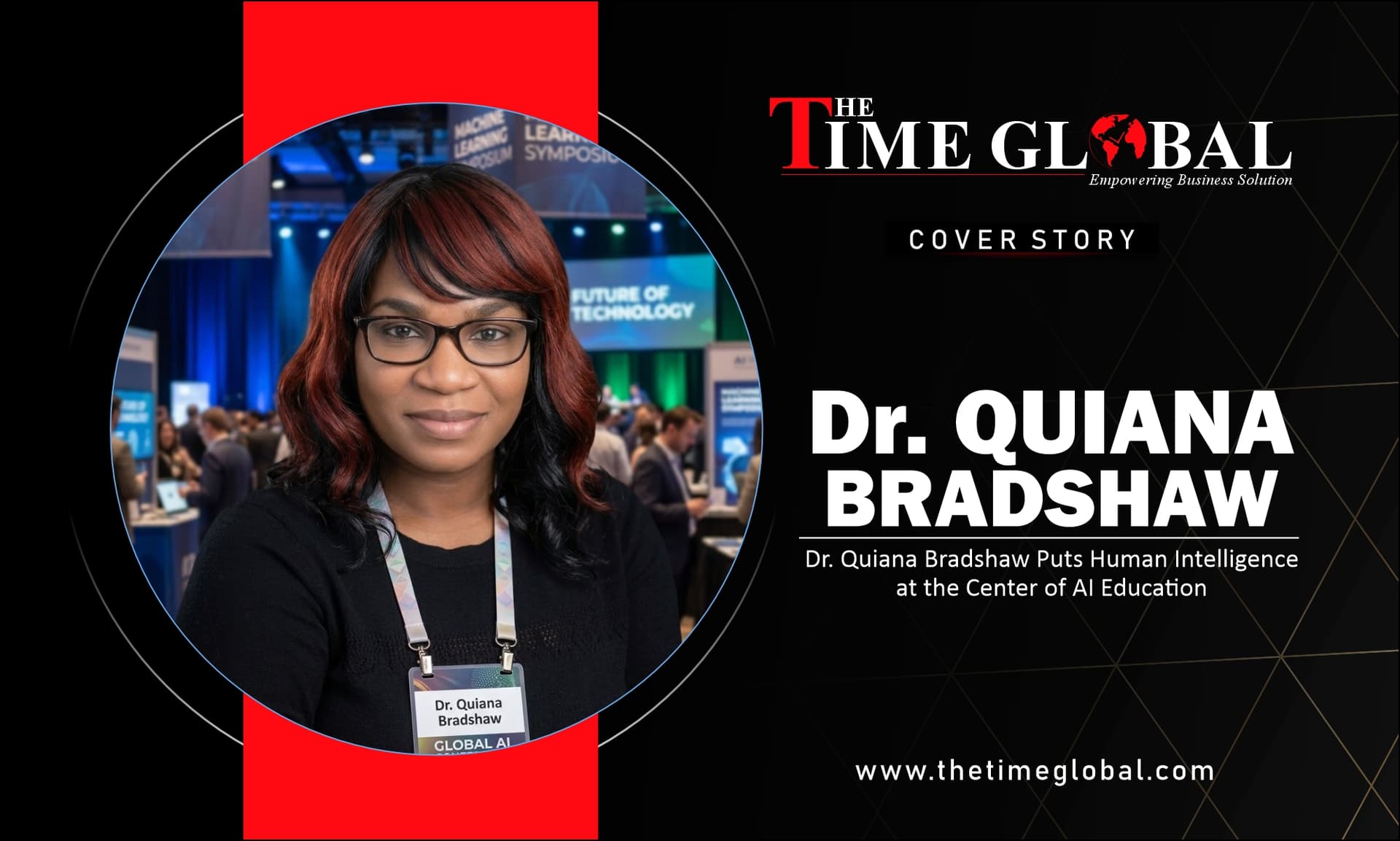
Dr. Quiana Bradshaw Puts Human Intelligence at the Center of AI Education
Key Takeaways
- Dr. Quiana Bradshaw serves as Academic Program Director for Emerging Technology at Columbia Southern University, bringing decades of front-line technical and academic expertise.
- She advocates shifting AI education from operational tool mastery toward cultivating critical judgment, verification habits, and ethical accountability.
- Her interdisciplinary foundation bridges computer science, game-based learning systems, virtual learning environments, and human-centered healthcare technologies.
- She emphasizes that technology is never the problem—the real measure is the human experience and tangible outcomes delivered for real people.
Dr. Quiana Bradshaw is a computer scientist and academic who believes AI education should build critical thinking, sound judgment and the ability to take responsibility for what technology produces.
Imagine a student submitting a flawless essay, only to be unable, moments later, to explain its central argument. For Dr. Quiana Bradshaw, the more important question is not what the student failed to understand, but what the assessment failed to measure. If a student can earn a perfect score without being able to defend the work, she argues, the assessment “probably isn’t measuring what we think it is.”
The example captures a broader conviction that shapes Dr. Bradshaw’s approach to AI education. A computer scientist and Academic Program Director for Emerging Technology at Columbia Southern University, she believes that preparing students for an AI-driven world requires more than teaching them how to use the tools. They must also learn to interrogate the technology’s outputs, evaluate their accuracy and take responsibility for how they are used.
Her perspective was shaped by more than theory. It took form across a career that spanned help desk support, telecommunications, game-based learning, teaching, and the virtual worlds she explored during her doctoral research.
West Philadelphia, Tron and a Father’s Textbooks
Dr. Bradshaw’s fascination with computing began at home in West Philadelphia, where technology entered her world through both imagination and example. Her father, an executive chef who was studying software engineering at night, brought home the original Tron. The film sparked a lasting fascination with games and digital worlds, while his programming textbooks offered a way to explore the technology behind them. Her older brother, meanwhile, was working at IBM, adding another connection to a field that was becoming part of her everyday life. Over time, she explored a growing range of programming languages and software, from FORTRAN and COBOL to Perl, BASIC, C and C++, as well as Lotus software. Looking back, a common thread runs through these early experiences: a curiosity about how technology works, how creativity shapes it and how people learn through it.
Built on the Front Line
Before entering higher education, Dr. Bradshaw built her expertise where technology meets everyday life: in IT help desk operations, technical support, programming and telecommunications. There, she encountered technology not as an abstract system, but as people experienced it when a connection failed, a process broke down or a tool that was supposed to help became an obstacle. Those moments shaped a conviction that continues to guide her work: technology is “never really the problem,” only “the human experience of the problem.”
For Dr. Bradshaw, technical excellence means little if it does not translate into something people can understand, trust and use. A system may be perfectly engineered, but if it leaves someone frustrated or unable to do their job, something important is missing. As she puts it, “Users don’t experience systems; they experience outcomes.” A properly configured server means little to someone who still cannot access the information they need. The real measure of technology is not simply whether it works, but whether it works for people.
That same commitment to helping people led her from technical support into the classroom, where she became an adjunct professor. The satisfaction she found in helping someone overcome a technical challenge carried naturally into teaching, where the opportunity was no longer just to solve an immediate problem, but to help others build the understanding and confidence to solve problems themselves. Each step reinforced the same principle: technology reaches its greatest potential when it responds to real human needs.
> “Academia gave me frameworks for understanding technology. The front line gave me respect for the people who must live with it.”
Games, Systems and AI
For Dr. Bradshaw, some of the most important questions about artificial intelligence began in the worlds of video games. Her doctoral research explored game design through the concepts of flow and the Elemental Tetrad, using World of Warcraft and Minecraft as case studies. These were more than virtual environments to study; they were opportunities to examine how design shapes experience, how people respond to challenges and how technology can influence the way we think, learn and interact.
That spirit of innovation extended to the program itself. Her dissertation chair, Dr. Cynthia Calonge, taught within immersive virtual worlds, conducting classes, projects and office hours inside the digital environments her students were studying. Dr. Bradshaw describes it as the best program she has ever been part of crediting Dr. Calonge as a mentor and innovator whose encouragement helped her grow. The experience demonstrated something powerful: technology does not simply give us new tools for learning. It can transform the learning environment itself, expanding where education happens and what it makes possible.
Games also gave Dr. Bradshaw a framework for understanding complex systems. Behind every engaging experience are rules, incentives, feedback loops and choices that shape how people behave and adapt. Artificial intelligence brings these dynamics into a far wider range of settings, from classrooms and workplaces to healthcare and cybersecurity. The questions that fascinated her in game design now carry even greater significance: How do people collaborate with intelligent systems? How do those systems influence human decisions? And what happens when technology can learn, adapt or generate rules rather than simply follow instructions?
For Dr. Bradshaw, the journey from games to AI is not a leap into unfamiliar territory. It is an extension of a longstanding curiosity about the relationship between people and technology. Both fields invite us to look beyond what a system can do and ask how it shapes the people who use it. As AI becomes increasingly capable, that human-centered perspective becomes more important not only to designing better systems, but to ensuring they serve the people and communities that depend on them.
Her recent publications reflect the breadth of that inquiry. In 2025, she published work on cybersecurity in the age of AI and co-authored a conference paper examining digital twin architecture for healthcare operations. Though distinct in application, both areas speak to a common challenge: how to develop and deploy increasingly sophisticated technologies thoughtfully, securely and in ways that address real-world needs.
A Record Built Across Disciplines
Dr. Bradshaw’s academic journey reflects a belief that learning is not a destination, but a lifelong pursuit. Her education spans computer science, information technology, business administration and higher education, culminating in a Doctor of Computer Science with a concentration in emerging media. Along the way, she earned a bachelor’s degree in information technology from Colorado Technical University, a master’s degree in information technology from the Florida Institute of Technology, two MBA degrees from Colorado Technical University and a master’s degree in higher education from Purdue University Global. Her achievements were recognized early in her career when she received the Outstanding Graduate in IT award at the Florida Institute of Technology for 2008–2009.
Yet Dr. Bradshaw has never treated education as something completed once a degree is earned. Instead, she continues to expand her knowledge as technology evolves, earning Google certificates in data analytics, cybersecurity, UX design and artificial intelligence, completing coursework in AI strategy and governance through Wharton, and obtaining a human-centered AI leadership certification from MIT AI-Powered Women. Her path reflects a commitment to staying curious, embracing new challenges and building the knowledge needed to navigate an ever-changing technological landscape.
That commitment extends beyond the classroom and into her work as an educator and thought leader. According to her professional biography, she serves as an Assistant Professor of Computer Science at Judson University, judges awards and shares her expertise at conferences, including Gatherverse AI summits, where she has participated since 2024. Across these roles, she brings together perspectives from technology, business, education and emerging media—demonstrating how learning across disciplines can open new possibilities for innovation and leadership.
Her journey offers an encouraging reminder: professional growth does not have to follow a single path, and expertise does not require standing still. Each new skill can build on what came before, opening doors to questions, opportunities and contributions that once seemed out of reach. For Dr. Bradshaw, continued learning is more than a personal achievement; it is a way to remain prepared to shape what comes next.
An Application Shaped by Experience
Some innovations begin not in a laboratory, but in the challenges, people face in their own lives. For Dr. Bradshaw, living with diabetes gave her a personal understanding of the importance of monitoring and managing blood glucose levels. While pursuing her doctorate, she turned that experience into an opportunity to create something that could help others, developing an application designed to support blood glucose monitoring and management. The project received Institutional Review Board (IRB) approval, and, according to Dr. Bradshaw, the application is ready for use as it moves through the copyright process.
For her, the project represents more than the development of a new tool. It reflects the determination required to carry an idea beyond its initial spark. Innovation, she believes, does not end when a concept takes shape. It demands documentation, an understanding of intellectual property and the willingness to seek guidance from mentors who can help turn an idea into a practical solution. It is a lesson she shares with her students: take your ideas seriously, document your progress and learn how to protect the work you create. A promising idea deserves not only imagination, but also the discipline and persistence to move it forward.
Her vision for the application reaches beyond its initial purpose. She hopes to develop it into a globally accessible platform that integrates with smartphones, smartwatches and fitness trackers, making it easier for people to incorporate monitoring into their daily lives. The ambition reflects her broader approach to technology, “its value lies not simply in what it can do, but in the difference, it can make for the people who use it. As she puts it, “More importantly, I want to create technology to help people.”
That same spirit of building something meaningful extends into her entrepreneurial life. Dr. Bradshaw is partnering with her husband, an experienced martial artist who is establishing Bradshaw’s Dojo & Gym. For her, the venture is about more than business; it is an opportunity to combine their strengths, support his vision and build something together. Whether developing technology or helping establish a business, she brings the same underlying principle to each endeavor: start with a purpose, commit to the work and keep moving toward what is possible.
Teaching Judgment
If Dr. Bradshaw could change one thing about AI education, she would shift its focus from teaching students how to use technology to teaching them how to think alongside it, question its outputs and judge when its answers deserve to be trusted. That shift, she believes, requires more than lectures and demonstrations. Students need opportunities to tackle messy, authentic problems where AI can assist but cannot do the thinking for them. They must encounter setbacks, navigate ambiguity, weigh conflicting evidence and confront ethical dilemmas. These are not obstacles to learning; they are where meaningful learning begins. “That’s where technological literacy becomes genuine judgement.”
The same principle applies to the workplace. Employers do not necessarily need graduates who have mastered every AI tool on the market. They need people who can identify the real problem, determine what matters, communicate their reasoning, collaborate with others and take responsibility for the outcome. As AI makes it easier to generate answers and produce polished work, the ability to evaluate those results becomes increasingly important. “So perhaps what employers are missing isn’t another technical skill. It’s judgement.”
The distinction is consequential. A graduate who can use AI to produce something impressive brings a useful capability to the workplace. A graduate who can also determine whether that work should be produced, verify whether it is accurate, anticipate whom it might affect and recognize when the technology has failed brings something more: the ability to exercise sound judgment when the answers are not obvious. In Dr. Bradshaw’s words, that graduate is “considerably more valuable.”
For Dr. Bradshaw, responsible AI extends beyond the classroom and beyond the technology itself. It is a question of governance, culture and accountability that must be addressed from the beginning in how systems are designed, which tools organizations procure, how people are trained and how outcomes are evaluated. Waiting until a system is deployed to consider its risks means waiting until important decisions may already have been made. Responsibility, in her view, must be built into the process from the start.
Moreover, Dr. Bradshaw’s vision of AI education is not about preparing students to compete with machines at producing answers. It is about preparing them to ask better questions, recognize the limits of technology and make thoughtful decisions when the stakes are real. In a world where AI can generate more of what once required human effort, the ability to exercise judgment may be one of the most important skills educations can cultivate.
Leadership That Creates Leaders
Students and colleagues, she suspects, would call her motivational, approachable and collaborative. She sees herself as enabling and purposeful: set a clear direction, then give talented people the trust and space to find the way. “I don’t think leadership means having the best answer in the room.” Often, she says, it is about asking the question that helps the group find a better one.
She is candid about the gap between how leadership looks and how it feels. Being calm and collaborative can seem effortless from the outside, she says, when underneath there is negotiation, difficult conversations and hard decisions. Support can also mean holding people to a higher standard, which is not always experienced as support. She does not want a culture in which everyone is comfortable, and nobody is challenged.
Her test is simple. People should come away from working with her with more confidence and dedication, not more dependence on her. She wants to inspire leaders who do the same, and to challenge them to go beyond what she has done.
She brings that innovation to game-based learning, the use of game mechanics and experiences to support learning. Games work best, she says, when the thing to be learned is a system, a decision or a consequence, because students can plan, see what happens, adjust and try again in a safe environment. Done well, they build intrinsic motivation. But she is wary of enthusiasm outrunning evidence. Engagement and learning are not the same thing, a beautifully designed game can create excitement without durable understanding, and sometimes a good discussion or a piece of writing teaches the concept better. She values evidence of learning over novelty.
Where She Is Looking Next
Over the next three to five years, Dr. Bradshaw expects AI to stop being a subject studied on its own and become part of almost every professional discipline, from medicine and law to design, business, engineering and the creative industries. Assessment will follow, she says, with more authentic projects, oral discussion, practical demonstrations, reflection and iterative work that reveal understanding rather than simply grade a final text.
Her advice to students is to prepare for what is least likely to become obsolete: deep subject knowledge, critical thinking, communication, creativity and the ability to keep learning. Then add enough AI fluency to understand how those capabilities can be augmented, and where they must remain distinctly human.
Her own thinking has moved since her doctorate. She once thought mainly about what emerging technologies could make possible. She is now far more skeptical of technological determinism. Adoption does not automatically produce change, she says, and an institution can install sophisticated technology and reproduce its old practices with a more expensive layer on top. The hard part of innovation is creating conditions in which people can question existing practices, experiment safely, learn from failure and change what isn’t working. She believes human intelligence deserves at least as much investment as the machines.
The same belief shapes how she sees leadership, which she describes as “less about predicting the future correctly and more about building the capacity to respond when the future inevitably turns out differently from your prediction.”
What She Hopes Stays
After eighteen years in higher education, Dr. Bradshaw says she is less interested in a particular project, publication or technology being remembered than in the people she has helped become more motivated, innovative and critical thinkers. She wants students to leave with more than a qualification: the confidence to enter unfamiliar territory, ask good questions, challenge assumptions, including their own, and use technology thoughtfully rather than follow whatever the latest tool tells them to do.
For the field, she hopes to have helped move the conversation beyond two extremes, the belief that technology will transform everything and the belief that it is destroying education. The interesting work, she says, lies in between, in understanding when a technology genuinely changes what is possible, when it does not and what conditions make the difference.
To young people from backgrounds like hers, she is direct. There will be moments when you feel you do not belong in the room, she says, and you cannot always wait for someone else to validate your ability. “Sometimes you must believe in your own potential before anyone else does.” Their experience, she adds, is an advantage. “You do not have to become someone else to succeed in technology. Bring your experiences, your questions, your creativity, and your unique perspective with you.”
As for her own legacy, she hopes former students and colleagues will remember her as generous with ideas and opportunities, someone who took their questions seriously and helped them see possibilities in themselves that they might not yet have recognized.
Frequently Asked Questions
Who is Dr. Quiana Bradshaw?
Dr. Quiana Bradshaw is a computer scientist, academic leader, and the Academic Program Director for Emerging Technology at Columbia Southern University, recognized for her human-centered approach to emerging tech and AI education.
What is Dr. Bradshaw's core philosophy on AI education?
She believes AI education should develop critical thinking, sound judgment, and personal responsibility, encouraging students to interrogate machine outputs rather than blindly trusting them.
How does game design connect to Dr. Bradshaw's work in AI?
Her doctoral research examined game systems, feedback loops, and player flow, providing models for understanding complex human-AI collaboration and systems thinking.