The EU vs China EV Battle: How Overcapacity in Shenzhen Is Threatening Factories in Munich
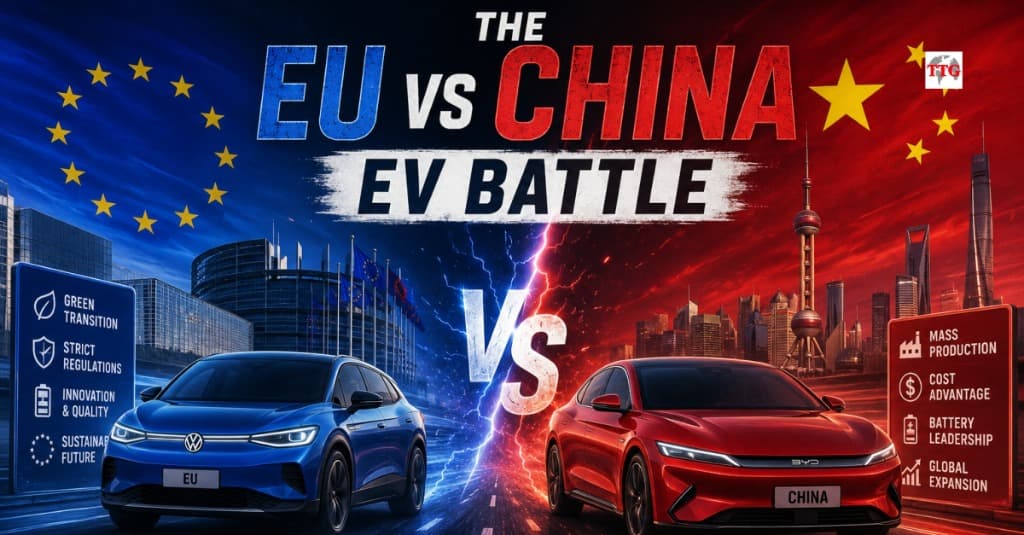
China's electric vehicle industry has achieved something remarkable: it has built global-scale production capacity so quickly, and at such low cost, that it is threatening the industrial foundations of Europe's most powerful economy.
This is no longer just a story about cars. It is a story about the future of European manufacturing - and how governments, companies, and workers are responding to a competitive challenge unlike anything the continent has faced in decades.
How China Got Here
China's EV dominance was not accidental. It was the product of two decades of deliberate industrial policy: massive state subsidies, protected domestic markets that allowed Chinese manufacturers to scale without foreign competition, forced technology transfer from joint ventures with Western automakers, and a national push on battery technology that has made China the undisputed leader in lithium-ion cell production.
BYD, now the world's largest EV manufacturer by volume, sells cars at price points that European manufacturers structurally cannot match - not because European cars are worse, but because the cost bases are incomparably different. A BYD Seagull starts at under $10,000. The cheapest European EV is more than three times that price.
Europe's Response
The European Union imposed tariffs of up to 45% on Chinese EV imports in late 2024. But as Lazard's 2026 geopolitical analysis notes, the focus is broadening. The problem is no longer just EVs - it extends to Chinese overcapacity in wind components, solar panels, and mature-node semiconductors. Each of these is a sector where European industrial capacity is at risk.
The political challenge within Europe is significant. Germany, whose automakers have deep supply chain entanglements with China, has pushed for negotiated solutions over tariffs. France and Italy, with less China exposure and more to gain from protection, have pushed for harder measures. The result has been a fractured European response that China has been adept at exploiting.
The Deeper Question
The EU vs China EV battle is, at its core, a test of whether liberal market democracies can compete with state-directed capitalism in strategic industries - and whether they are willing to use the same tools.
The answer emerging in 2026 is that Europe is moving toward a hybrid model: market competition within Europe, but active industrial policy to protect strategic sectors and attract investment in next-generation manufacturing. Whether it is too late - and whether the political will can be sustained - are the questions that will define European industrial fortunes for the next decade.