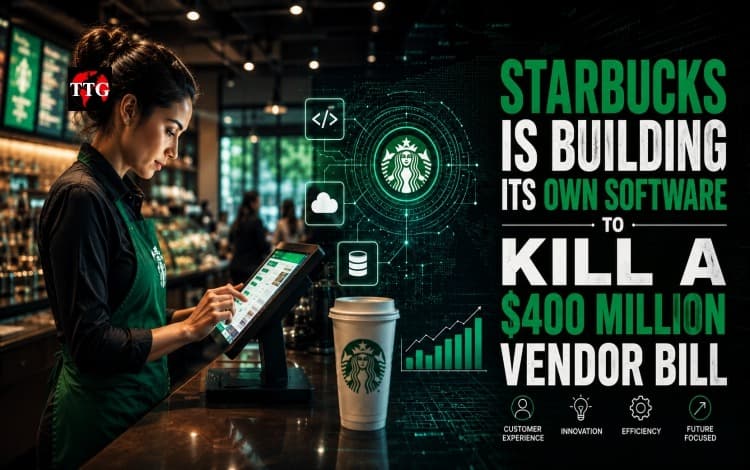
Starbucks Is Building Its Own Software to Kill a $400 Million Vendor Bill
Key Takeaways
- Starbucks spends roughly $400 million a year on enterprise software and is now building AI-assisted, in-house replacements for Microsoft and IBM tools.
- The company’s CTO has said publicly there are clear opportunities to reduce software spend, with some new internal tools expected to roll out by the end of 2027.
- Analysts estimate up to 20% of enterprise software spending industry-wide is now exposed to this kind of "agentic arbitrage."
For two decades, the economics of enterprise software were simple and largely one-directional: building a system in house was expensive, so companies bought from Microsoft, IBM, Oracle, and their peers instead. Starbucks’s current project is a direct test of whether that logic still holds now that AI-assisted development has meaningfully lowered the cost of building software internally.
The $400 Million Software Target
The specifics are concrete rather than aspirational. Starbucks spends approximately $400 million annually on software, according to comments its CTO made to employees earlier this year, and the company is now developing AI-assisted internal alternatives to two systems it currently licenses: a Microsoft platform used for inventory tracking, and an IBM tool used for maintenance management across its stores. Some of these internally-built replacements could roll out by the end of 2027, pending testing results.
Insourcing the Middle of the Software Stack
What makes this a genuine case study rather than a press-release aspiration is the specificity of the target systems. Inventory tracking and maintenance management are not glamorous, headline-grabbing software categories — they are exactly the kind of unglamorous, deeply operational tooling that encodes how a specific business actually runs day to day. That’s precisely the category industry observers expect to be most exposed to AI-assisted insourcing: not the flashy customer-facing applications, but the middle of the software stack that most closely mirrors a company’s own operational quirks, and which off-the-shelf vendors have historically had to generalise across thousands of customers to serve.
Technical Risks and Engineering Liabilities
The risk side of the ledger is real and worth stating plainly. If Starbucks’s internally-built tools underperform, the company will have traded a predictable licensing cost for a permanent internal engineering and support obligation, spread across thousands of operationally demanding retail locations. Maintenance platforms in particular tend to accumulate years of integrations — equipment records, service histories, work orders, parts inventories, technician scheduling — that are considerably harder to reconstruct than the visible workflow alone.
Market Implications: The Rise of Agentic Arbitrage
The market has taken notice regardless of how the specific project ultimately performs. Analysts now estimate that up to 20% of all enterprise software spending faces some exposure to this type of agentic arbitrage over the coming years, and Gartner has projected that the share of enterprise applications embedding AI agents natively will grow roughly eightfold in a single year. If Starbucks can build a working inventory system for a fraction of what it currently pays Microsoft to license one, the pressure on every enterprise software vendor selling “the middle of the stack” — not just the flashy top layer — gets considerably harder to ignore.
Frequently Asked Questions
Why is Starbucks building its own enterprise software in-house?
AI-assisted development has dramatically lowered software build costs, enabling Starbucks to replace expensive Microsoft inventory and IBM maintenance management software to reduce its $400 million annual software spend.
What is 'agentic arbitrage' in enterprise software?
Agentic arbitrage is the economic shift where enterprises replace off-the-shelf SaaS licensing with custom, in-house software generated and maintained using AI coding agents.