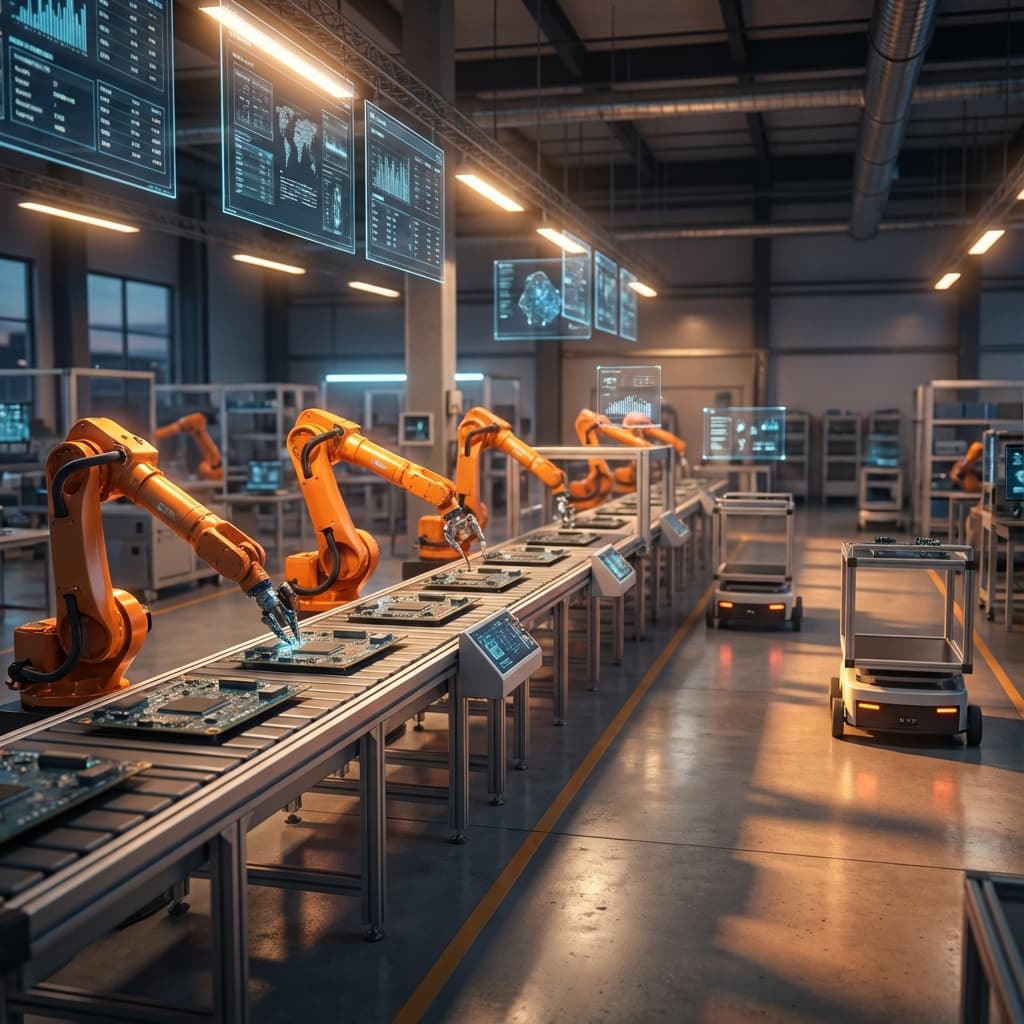
The manufacturing industry is undergoing a powerful transformation that surpasses simple automation. By 2026, the integration of smart factories, digital twins, and real-time data analytics is creating production systems that are not just efficient, but regenerative.
The Power of Digital Twins
Digital twins have evolved from static models to living simulations. In 2026, every piece of equipment on the factory floor has a digital counterpart that mirrors its state in real-time. This allows for 'Predictive Orchestration' - where the system identifies potential structural failures or logistical bottlenecks before they occur. By simulating millions of production scenarios per second, manufacturers can optimize energy consumption and material usage with unprecedented precision.
Generative Design and AI Orchestration
Design is no longer a bottleneck. AI-driven generative design systems are creating components that optimize material use by up to 40% while increasing structural integrity. These systems explore thousands of geometric possibilities that a human engineer might never consider, resulting in parts that are lighter, stronger, and more sustainable. In the factory of 2026, human operators have transitioned into 'Systems Architects,' overseeing fleets of autonomous robots that can reconfigure their workflow based on real-time demand shifts.
Resilient Supply Operations
The 'Just-in-Time' model has evolved into 'Just-in-Case' resilience. Factories are now equipped with on-site additive manufacturing (3D printing) capabilities to create critical spare parts locally, reducing dependence on fragile global supply chains. This industrial era is defined by the marriage of intelligence and sustainability, where waste is viewed as a resource flaw rather than an inevitability. By localizing production and closing the loop on material waste, smart factories are leading the charge toward a circular economy.