The Leader Who Refuses to Let Cost, Quality, and Delivery Compete
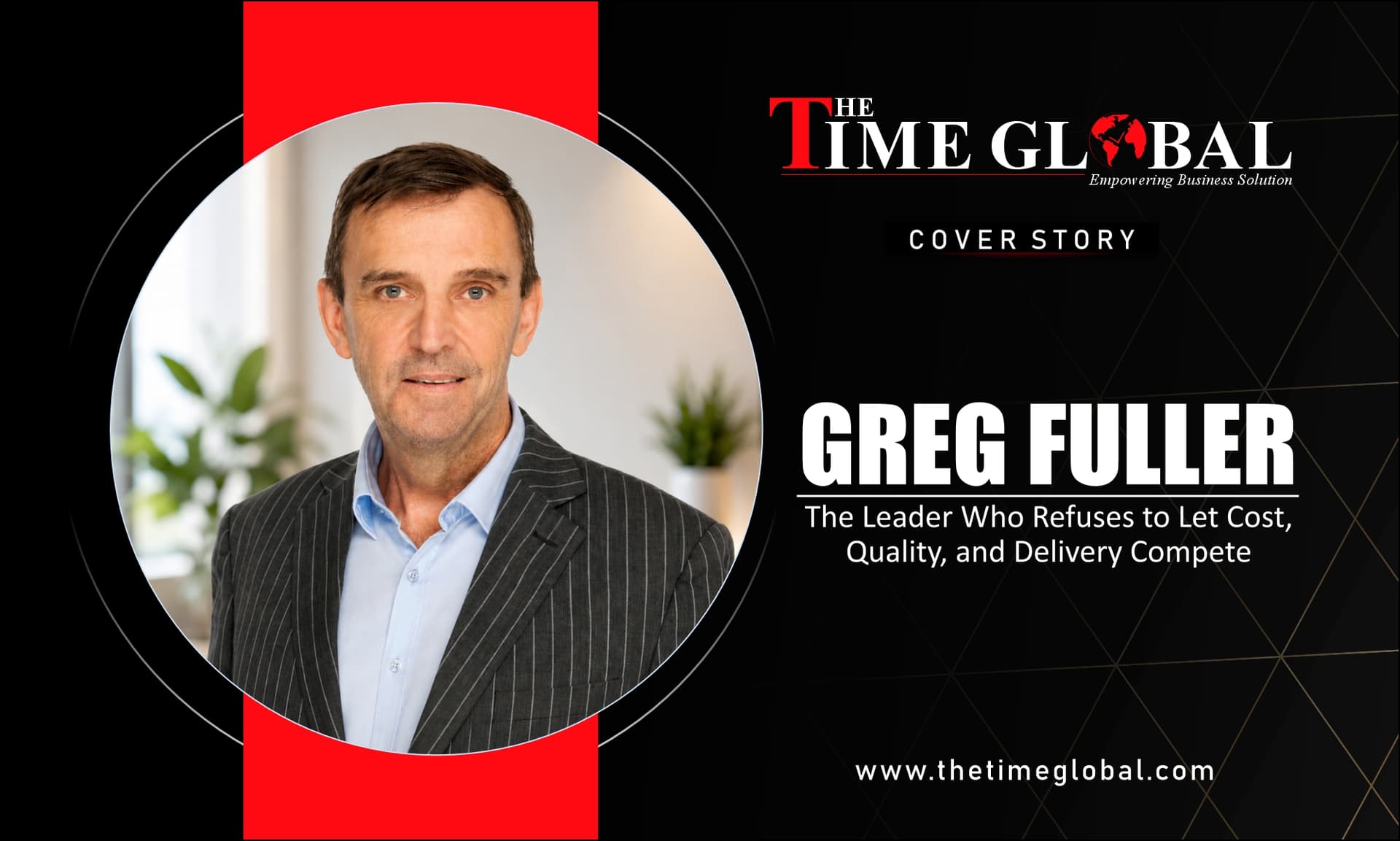
The Leader Who Refuses to Let Cost, Quality, and Delivery Compete
There is a particular kind of authority that comes not from mastering one discipline but from refusing to let three of them work against each other. Most senior figures in construction rise through delivery, or through engineering, or through the commercial side of the business, and they stay there. Greg Fuller did something different. Over more than four decades, he built a career at the intersection of procurement, quality, and project management, functions that in almost every organization on earth are kept in separate silos, often quietly undermining one another, and made them operate as a single, unified system. Today, as director of procurement, quality, and project management in the United Arab Emirates, he is one of the clearest examples in the region of what happens when someone stops treating cost, compliance, and delivery as three different conversations and starts treating them as one.
His training in construction management in Australia placed him inside a small, specific tradition, one shared with New Zealand, Canada, and South Africa, where procurement, commercial contract management, and project delivery are taught and practiced as a blended discipline rather than three competing departments. Almost everywhere else in the world, these functions are not just separate. They actively work at odds with each other. Fuller has spent his career proving, market by market, project by project, that they do not have to.
A Career Built on Convergence
Fuller's first position on a major project was in procurement, and it was managed on the project itself, not tucked away in a back office. That early placement shaped everything that followed. Where many organizations still treat procurement as a purely cost-driven function, Fuller has spent decades arguing and demonstrating that the real job is considerably broader: balancing price against quality, warranty terms, delivery lead times, spare-part availability, warehousing capacity, and contractual and credit terms, all at once, and all with genuine input from the site.
"Procurement alignment should not be about obtaining the cheapest deal but the best deal for the project," he says. Strip out the site-level input, he warns, and the consequences arrive quickly: deliveries that miss the program, quality that falls short of client expectations, and contractual terms that satisfy no one. It is the foundation of his entire case for treating procurement not as a support function, but as an integral part of the whole project's management system.
Quality Without the Price Tag
If procurement is misread as a cost lever, quality suffers the opposite misconception, that protecting standards inevitably means paying more. Fuller rejects that framing outright, and the reasoning is characteristically precise.
"Correct construction practices actually cost less to achieve than cutting corners, which in turn requires rework or additional labor and material to fix items out of alignment," he explains. In his view, quality begins at design inception, embedded through coordination and sequencing that matches the real skill level of the trades available on a project, not bolted on as a finishing touch, and never treated as a last-minute snagging exercise rather than a discipline carried through every stage from design to installation.
Built for Giga-Scale: The UAE Advantage
The UAE's construction sector, defined by giga-projects, compressed delivery timelines, and a supply chain that spans the globe, has pushed Fuller's systems to a level of granularity most firms never attempt. Where a typical project program might run to roughly 2,000 activities, his systems run to 25,000. On a single 40-floor tower, tracking cost down to individual floor level turns 300 to 400 line items into 12,000 to 16,000; at his preferred resolution of close to 2,000 cost lines per floor, the dataset for one building alone can reach 80,000 lines and, across a full portfolio of units, into the hundreds of thousands.
"Normally this idea disappears as soon as they see nearing 10,000 items, let alone what I manage," Fuller says. "But I've developed a system that is simple to manage even at this extreme level of data control and allows the project to be proactively managed accordingly." Born out of necessity on the Gulf's largest developments, the system, he notes, now supports internationally based construction just as effectively. It simply started from the extreme end of the scale.
Leadership as Shared Ownership
Fuller describes his leadership style as giving space to think and grow, rather than exercising direct control, a philosophy that might sound at odds with an industry defined by tight schedules and safety-critical decisions. He argues the opposite is true.
"If you try to control solely, then your control is by name only. True control comes from leading, from thinking through and using all available input to move forward."
Discipline, in his model, is taught rather than assumed to be instinctive, and it holds across a team because the team has bought into why the rules and processes exist, not merely because they have been told to follow them. Pressure, he says, becomes shared rather than concentrated, because people are willingly doing their part rather than the bare minimum required of them.
Reading the Data, Keeping the Judgment Human
As AI enters procurement and quality management, from automated supplier evaluation to predictive risk flagging, Fuller is unambiguous about where he draws the line. His own systems are built to present reporting and options, never decisions.
"Every choice in life forms a compromise in one way or another, and whether you are willing to accept that compromise does not relinquish the fact that it is a compromise," he says. A computer or AI system, in his framing, goes only on data, which may or may not suit the best choice for that moment and should be used for informing a decision rather than making it. He is equally direct about the risks of the current AI moment: an explosion in available data has not been matched by an explosion in clean, well-sourced data, and knowing the origin and basis of a dataset now matters more than it did a decade ago, particularly in a region like the GCC, where data protection regulation does not carry the same weight as GDPR does in Europe. NDAs, in his practice, now come before anything else.
Weathering the Storm
Long, fragmented, globally dependent supply chains are a defining vulnerability of modern construction, and Fuller has managed through most of the ways they can break: sudden material unavailability triggered by war or shifting legislation, currency swings on long-lead items, collapsed logistics partners, and lost or damaged shipments. The most severe, he says, was the global shipping shortage driven by conflict, which delayed deliveries on his projects by up to several months and forced widescale rescheduling across every affected site.
His answer is structural rather than reactive: a standing contingency plan, continuous risk monitoring until goods are physically received, and ongoing tracking of economic activity in every country in the supply chain, a discipline aimed at forecasting disruption before it arrives rather than absorbing it after the fact.
Trust Before Transaction
For international suppliers eyeing the UAE and the wider GCC, Fuller identifies one recurring and expensive misunderstanding: assuming a cheaper or ostensibly better product will be accepted on its merits. In a market built on relationships, that is rarely how it works.
"Trust and confidence in a product here are much more important than the prima facie of the product itself."
Relationship-building, in his experience, has to come before product acceptance, a sequencing that new entrants to the market consistently underestimate and one that takes considerably longer than they expect it to.
Sustainability as a Triangle, Not a Slogan
Fuller's view of sustainability extends well past its environmental headline. He frames it as a triangle, environmental, social, and economic sustainability, that collapses if any one side is neglected. In procurement terms, that means evaluating suppliers not just on unit cost but on lifecycle cost, CO₂ emissions across both manufacture and transport, lead times, credit terms, and the broader economic and social impact of a sourcing decision.
He has already built two-tier emissions tracking into his own systems, local delivery emissions to site and warehouse, and the emissions generated at the original point of manufacture, giving procurement teams a fuller picture of impact at every stage. With all the information prepared together, he says, decisions are fully informed, and the triangle of sustainability stays balanced.
The Road Ahead: Net Zero and a National Platform
Fuller expects the defining shift of the next three years in Middle East construction to be sustainability reporting made mandatory, driven by Decree 11, which extends emissions reporting obligations beyond manufacturers to consultants, offices, and shops across the UAE. He sees the shift as fundamentally an education challenge before it is a technical one and has positioned himself squarely inside the government's efforts to hit its 2050 net-zero targets.
That ambition now runs alongside a formal platform. Fuller currently serves as National Chairman of the Asian African Chamber of Commerce and Industry, work he hopes will draw together international ties with the UAE specifically around construction and sustainability. He is also completing a doctorate in business administration in construction management, with a thesis examining how sustainability affects cost and program delivery in the UAE and how that impact can be actively managed and mitigated rather than simply absorbed.
The Legacy: Education Over Everything
Asked what he is ultimately working toward, Fuller does not point to a single project or partnership, though he is visibly proud of the granular, per-unit cost and emissions reporting system he has built, one that lets sustainability sit inside the same budget approval process as every other commercial decision on a project. Instead, he points further out.
"My legacy, so to speak, is to bring understanding and education to the industry of what sustainability actually is and the systems I've developed to help manage your impact and future impact in a simple manner."
Unlike many sustainability consultants, Fuller brings genuine, decades-deep project and cost management expertise to that mission, a combination he believes is rare and one he intends to keep using as a driving force behind the UAE's net-zero goals, one live dataset and one unified project team at a time.