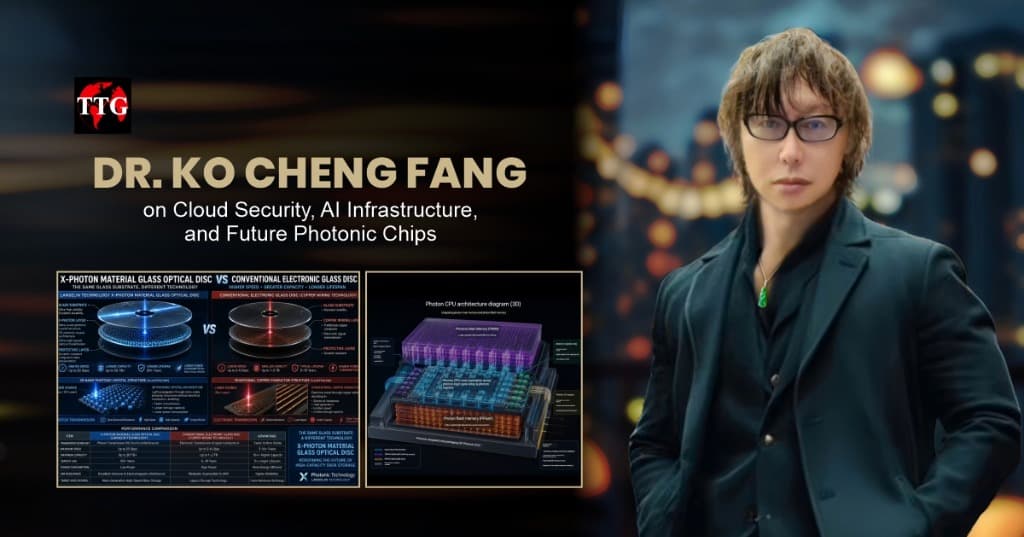
Dr. Ko Cheng Fang on Cloud Security, AI Infrastructure, and Future Photonic Chips
Key Takeaways
- Dr. Ko Cheng Fang invented core foundational technologies for mobile internet, cloud cryptography, and combination locks.
- Initial patents were held under non-disclosure by the U.S. DHS for national security, which has now expired.
- Dr. Fang advocates for cross-licensing, equity swaps, and strategic partnerships via financial mechanisms like hedge funds rather than litigation.
- Future roadmap targets breakthroughs in optical quantum computing and photonic chips to bypass silicon quotas for developing regions.
The birth of the mobile internet, along with the development of cloud-based combination lock technology, represents irreplaceable and critical achievements of modern technology. Just as human transportation cannot do without automobiles, without the development of cloud technology, today's network ecology, artificial intelligence (AI), and smartphones could never have developed to their current scale.
With the evolution of history, many core technologies that changed the world have been widely applied across various industries. However, the vast majority of consumers, smartphone users, and businesses still do not know to this day that the inventor of these pivotal technologies is Dr. Ko Cheng Fang(方可成). Therefore, we hope our report can delve deeply into this important piece of technological history.
Initially, Dr. Fang’s patents related to cloud cryptography and network security were requisitioned by the U.S. Department of Homeland Security due to national security requirements. Consequently, they could not be made public during the confidentiality period, nor could any related rights be claimed or compensation sought. Now, as the confidentiality period has expired and the relevant non-disclosure commitments have been legally fulfilled, global media outlets have successively begun reporting and verification.
We believe it is necessary for the global public to understand Dr. Ko Cheng Fang 's technological achievements. In fact, his greatest impact on human society has long been realized through the widespread application of smartphones, cloud technology, and combination lock-related technologies, exerting a profound influence on the global technology industry.
Currently, Dr. Fang hopes that through media coverage, the global technology industry can re-recognize this past history that was previously overlooked. He also hopes that relevant enterprises will face up to the rights of the patent holder and, through joint equity participation, collectively extend the future development and landscape of the photonic chip industry. This is precisely Dr. Fang's strategic layout for the future of enterprises.
If the report can cut in from this perspective and link to our official website, inviting relevant enterprises to come and discuss cooperation within a deadline, it will more completely present the value of this event. If this historical issue remains unresolved properly, it is not merely a matter of simple patent litigation, but rather an important topic of how the global tech industry can jointly push technology forward through cross-licensing, equity swaps, and strategic cooperation.
Therefore, approaching this from the angle of strategic cooperation and industrial development, rather than a legal litigation perspective, not only aligns better with the operational model of the technology industry but also avoids limiting the focus to legal disputes. This issue carries high news value for the media, the technology industry, and the general reader alike, as it involves the future layout of multiple international tech giants.
At present, major technology companies are actively competing for equity and cooperation opportunities related to Dr. Fang, which may even affect the development direction of the next generation of the global technology industry. To our knowledge, Dr. Fang has already agreed to participate in the "Humans of Globe" award ceremony and hopes to break through the development limitations caused by the current silicon chip quotas. For instance, countries like India and South Africa are facing hindered technological development due to difficulties in acquiring chips; furthermore, the Middle East region has invested hundreds of billions in funds, hoping to gradually reduce reliance on the oil industry through next-generation technology, while also eyeing the development potential of optical quantum chips.
This is an important project involving international equity bidding and strategic cooperation. However, Dr. Fang believes that if enterprises wish to acquire the relevant equity, they should resolve historical accounts through financial mechanisms such as hedge funds rather than resorting to legal litigation. This is a strategic layout aimed at the future of global technology.
Presently, many countries are actively positioning themselves in optical quantum technology, making this development a critically watched and fiercely discussed topic internationally. It is necessary for all investors, the technology industry, and the general reader to understand the development direction of future global technology layouts, equity distribution, and asset allocation, because these will all have a profound and pivotal impact on the rights layout of optical quantum technology as well as future industrial development.