Blended Finance, DFIs, and the Slow Death of Traditional Aid: How Global Development Is Being Rewired
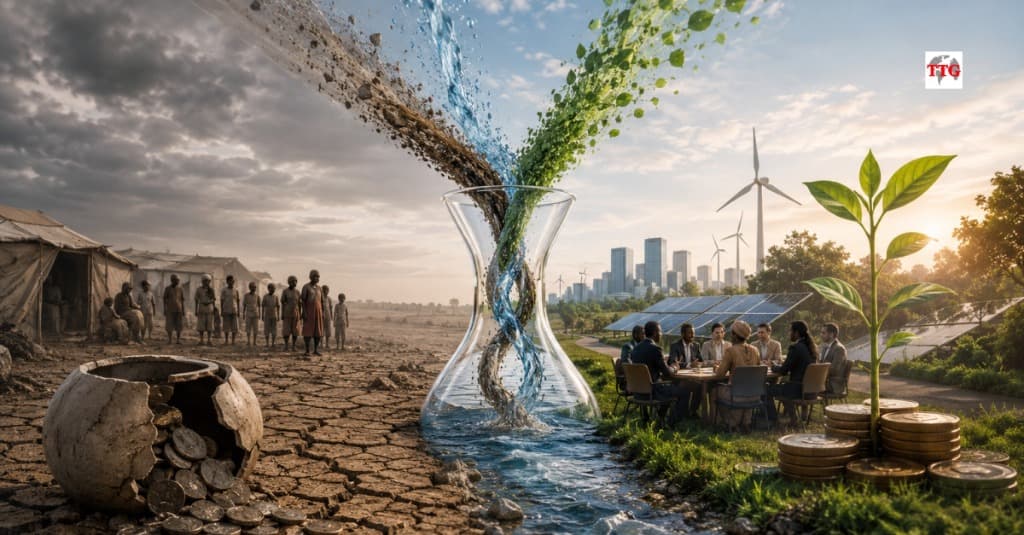
The architecture of global development finance - the system of aid, loans, and grants that has funded economic development in poorer countries since the end of World War II - is undergoing the most significant structural transformation in its 75-year history.
The change is not being driven by a grand reform agenda or a new international agreement. It is being driven by the withdrawal of traditional donor funding at precisely the moment when development needs are most acute.
What is filling the gap - blended finance, development finance institutions, private capital, and philanthropy operating with very different incentives from traditional aid - is creating a development finance ecosystem that is simultaneously more resource-rich and more complex, more market-oriented and more unequal in its geographic reach.
Understanding this transformation matters not just for development practitioners, but for any business or investor operating in emerging markets, and for anyone who cares about whether the global development system can actually deliver on its mandated purpose.
The Aid Contraction Is Structural
Multiple analyses published in 2025 and 2026 converge on an uncomfortable conclusion: the decline in traditional donor funding for development is not a temporary downturn. It is a structural transition that reflects deep changes in the political economies of donor countries.
Rising domestic spending pressures - on healthcare, pension systems, climate adaptation, and defence - are competing for budget space that once funded overseas development assistance. Populist political movements across donor countries have made foreign aid politically toxic in ways that make significant increases unlikely under almost any plausible government configuration.
The OECD's Development Assistance Committee official development assistance figures have stagnated in real terms and declined as a share of donor country GNI. The US Agency for International Development has undergone significant restructuring. European aid budgets are under pressure. The UK's aid budget has been repeatedly reduced from its 0.7% of GNI commitment.
The multilateral system is also under strain. WHO financing reform, questions about the future of the Global Fund and GAVI, and broader UN restructuring are unfolding against a backdrop of sovereignty tensions and funding uncertainty from major contributors.
What Blended Finance Actually Is
Blended finance is the use of public or philanthropic capital to reduce risk and attract private investment into development contexts that would otherwise be considered too risky for commercial returns.
The mechanics are varied. A guarantee from a development finance institution might cover the first 20% of losses on a portfolio of small business loans in sub-Saharan Africa, enabling a commercial bank to lend at rates that are viable for borrowers and acceptable to shareholders. A concessional loan from a multilateral might provide the patient capital component of a mixed-finance infrastructure deal, enabling a private equity fund to participate.
The theory of change is compelling: public money can leverage far larger volumes of private capital, potentially mobilising resources at a scale that official aid could never achieve alone.
The practice is more contested. Critics argue that blended finance consistently mobilises capital for the most commercially attractive projects in the most commercially attractive countries - upper-middle-income countries with established legal systems, currency convertibility, and existing investor interest - rather than for the fragile states and least developed countries where development need is greatest.
The evidence broadly supports this critique. Blended finance flows are heavily concentrated in sub-Saharan Africa's more commercially developed economies, Southeast Asia, and Latin America - not in the DRC, Haiti, Yemen, or the countries where traditional aid was most impactful.
Development Finance Institutions: The New Power Brokers
Into the space vacated by traditional aid, Development Finance Institutions (DFIs) have grown dramatically in scale and ambition.
The US International Development Finance Corporation (DFC), the UK's British International Investment (BII), the European Development Finance Institutions (EDFI) network, and the World Bank's International Finance Corporation (IFC) collectively deploy hundreds of billions of dollars annually in private sector investments across developing economies.
These institutions are explicitly market-oriented. They are mandated to achieve development impact through commercial investment, rather than through grants or highly concessional lending. They take equity stakes, provide debt financing, and offer risk guarantees to mobilise private capital - and they are increasingly coordinating with each other to crowd in additional investment.
The geopolitical dimension is explicit and growing. The US DFC's mandate includes advancing US foreign policy objectives; investments in strategic corridors, critical mineral supply chains, and digital infrastructure are as much about competing with Chinese Belt and Road investment as about development impact per se.
Private Capital's New Appetite for Emerging Markets
Beyond DFIs, a broader shift in private capital allocation is underway. Impact investing - capital deployed with the explicit intention of achieving measurable social or environmental outcomes alongside financial returns - has grown from a niche to a meaningful asset class.
ESG-mandated investment funds are increasingly screening for exposure to development-relevant sectors: clean energy, healthcare infrastructure, financial inclusion, sustainable agriculture. The capital is real, even if the definitions are contested and the measurement frameworks immature.
Family offices and high-net-worth individuals, disillusioned with the pace of change through philanthropy alone, are moving toward hybrid models that combine grant-making with impact investment. Some of the world's most sophisticated development finance is now being designed and deployed by private foundations with investment offices that operate like sovereign wealth funds.
The Geography of the New Development Finance
The clearest consequence of the shift from traditional aid to blended and private finance is geographic: it reinforces the development gap between countries that are commercially bankable and those that are not.
Upper-middle-income countries with stable governance, rule of law, currency convertibility, and existing investor relationships are capturing a disproportionate share of the new financing flows. They were already better placed to develop; the new system makes their advantage larger.
The countries with the greatest development needs - low-income fragile states, countries affected by conflict or climate shocks, nations with governance challenges that make commercial investment unattractive - are, if anything, more dependent on traditional grant aid than before. And that grant aid is contracting.
What Should Change
The gap between the rhetoric of development finance reform - mobilising trillions for the Sustainable Development Goals - and the reality of capital flows is wide enough to require more than incremental adjustment.
What is needed, but politically difficult, is an honest renegotiation of what the international development system is actually for. If the objective is sustainable economic development for all countries, then the financing instruments need to be designed around the least bankable contexts, not the most. If the objective is mobilising private capital efficiently, that is a different goal that will produce different geographic outcomes - and the discourse should be honest about that distinction.
The development finance system being built today will shape economic trajectories, geopolitical alignments, and migration pressures for a generation. The decisions being made now - about what to finance, where, on what terms, and with what accountability - deserve far more public scrutiny than they are currently receiving.